
The plan sounds clean. Sell the city flat. Buy a smaller place somewhere calmer. Keep the difference.
And the tax? People wave that away. I bought another house, so there is no tax. That is true only if you spend the whole gain. Downsizing means you deliberately spend less. So part of the gain stays taxable. Most people find this out after the money is spent.
How the relief actually works
Sell a home you have held more than two years and the profit is a long term gain. Buy another home and you get relief on it. But the relief is capped. It is the lower of two things. Your gain, or what you actually spend on the new place. Read that again, because it is the whole article. Spend less than the gain and the gap is taxed. Someone trading up never notices this rule. They spend more than they made, so the limit never affects them. A downsizer is caught by it every time.
A real set of numbers
Take a flat bought in 2008 for ₹40 lakh. It sells today for ₹2.50 crore. The gain is ₹2.10 crore. Our seller buys a villa in a smaller city for ₹1.20 crore. Job done, they think. The relief is ₹1.20 crore, because that is what was spent. The gain was ₹2.10 crore. So ₹90 lakh is still taxable. At 12.5% plus cess that is a bill of ₹11.70 lakh. On a sale they believed was fully covered.
There are two ways to work out the gain
Here is where it gets interesting, and where most advice stops too early. If you bought the property before 23 July 2024, you get a choice. You can work out the tax two ways and pay the lower one.
- 12.5% on the plain gain. Sale price less what you paid. Nothing else.
- 20% on the smaller gain. Your old cost is lifted for inflation first, using an index the government publishes each year. A higher cost means a smaller gain.
For this flat the index lifts the ₹40 lakh cost to ₹1.12 crore. So the second method puts the gain at ₹1.38 crore instead of ₹2.10 crore. Bought on or after 23 July 2024, there is no choice. It is 12.5% and no inflation lift. People who do not live in India get no choice either.
The part that catches everyone
With no new house, the first method wins here. ₹27.30 lakh against ₹28.68 lakh. So that is the one everybody picks. Now buy the ₹1.20 crore villa and the answer turns over completely. Why? Your ₹1.20 crore is a fixed amount of money. Set against a gain of ₹2.10 crore it covers a little over half. Set against a gain of ₹1.38 crore it covers nearly all of it.
The smaller gain is easier to cover. So the inflation method, which looked worse, becomes much better.
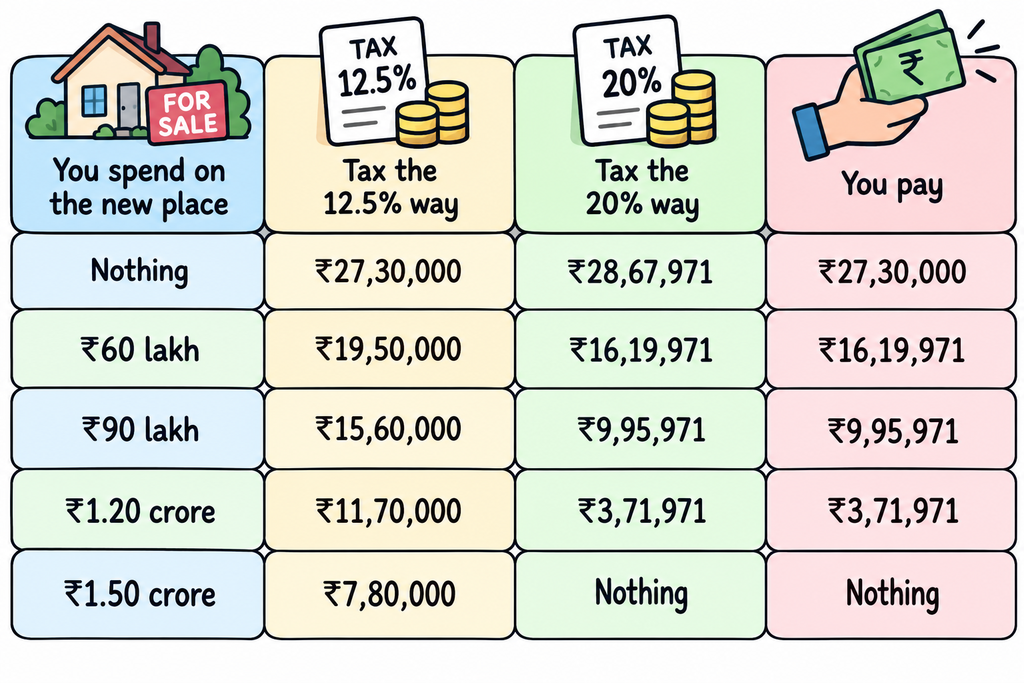
Look at the ₹1.20 crore row. Picking the right method saves ₹7.98 lakh. Same flat, same sale, same villa. Only the sum on the form changes. And look at the last row. The inflation method clears the tax fully at ₹1.50 crore. The other method would need ₹2.10 crore to do that, and a downsizer is never going to spend it.
So the advice everyone repeats, that the lower rate is the better deal, is wrong for downsizers.
Bonds for whatever is left
There is a second relief. Put the leftover gain into certain government backed bonds within six months and that part is exempt too. The limits matter. Up to ₹50 lakh, counted across this year and the next together. Locked for five years. They pay about 5.25% today, and that interest is taxed as ordinary income. Everyone says buy them. The sums are closer than that.
Because skipping the bonds does not cost you the whole amount. It only costs you the tax on it. So you are choosing between a big sum growing slowly under lock, and a smaller sum growing normally with no lock.
Work that through over the five years and you get a break even number.
- On the 20% method, bonds win unless you can earn about 8.6% a year. For most people at this stage, that makes them worth buying.
- On the 12.5% method, bonds only win below about 6.6% a year. You are locking the full amount to save a much smaller tax. Often not worth it.
That second line surprises people. When the rate on gains was cut, it quietly made these bonds a weaker buy. Less tax to save, same five year lock.
One more thing. Buy only as much as the leftover gain. If ₹18 lakh is exposed, ₹18 lakh of bonds clears it. Buying ₹50 lakh because that is the limit just locks up money for nothing.
The dates that undo all of this
The relief has deadlines, and missing one cancels it.
- Buying. One year before the sale, or two years after it.
- Building. Three years after the sale.
- Bonds. Six months from the sale. This one is short and it does not move.
- Money not yet spent. Park it in a special bank account meant for this before your return is due. Leave it in your savings account and you lose the relief on it, even if you buy later.
That last one is the quiet one. The sale closes in October, the villa is picked but not paid for, and the money sits in a savings account over the summer. The relief on it is gone. Two smaller rules worth knowing. The relief counts at most ₹10 crore of what you spend on the new place. And if your gain is under ₹2 crore you may buy two houses instead of one, but only once in your life.
The capital gains calculator works out the plain gain and the tax at 12.5%. The inflation comparison in this article is not in it, so do that part on paper or with your accountant.
What could go wrong
- The figures here are one example. Change the year of purchase and the two methods can swap places. The point is to do both sums, not to copy this answer.
- Stamp duty and registration count as cost. So do genuine improvements, if you kept the bills. Most people forget them and overstate their gain.
- The new house has to stay yours. Sell it within three years and the relief is pulled back into tax.
- A smaller city is a smaller market. The tax is a one off. Ten years on, a villa that nobody wants to buy is the bigger problem. Rent or buy covers how to think about that.
- This is one sale, not a plan. What the leftover money does for the next thirty years matters far more. The three buckets covers drawing an income from it.
What to do with this
- Work out the gain both ways before you sell anything. You need the purchase year, the price, and the bills. This is an afternoon of work and it is worth lakhs.
- Then ask what the new place costs. The gap between that and your gain is what gets taxed. Knowing the number early may change what you buy.
- Decide on the bonds using the break even, not the headline. If you would leave the money in deposits anyway, buy them. If you invest properly, think again.
- Put the date of sale in writing and count forward. Six months, one year, two years, three years. Diary all four.
- Pay someone for this one. A sale this size, with a choice of method, is worth a few thousand rupees of proper advice.
Downsizing is usually a good decision. More money, less house to look after, a slower place to live. It just is not the tax free decision people assume. You spent less than you made, and the difference gets noticed.
This article is for learning. It is not personal tax or financial advice, and no bond, fund or company is named or backed here. The figures use the rules and the inflation index for the tax year 2026-27, and a flat bought in 2008. Rates, limits and the index change, and your own dates and costs will give different answers. The bond comparison assumes interest taxed at 30% and reinvested, which may not match your case. For your own sale, speak to a chartered accountant before you commit to anything.