

Most Indian families move money the same way. You hold on to it, and it passes when you go. Giving with a warm hand means the opposite. You help while you are alive. You get to see it used, and you get to say what it is for. People worry this costs tax. Mostly it does not. But one rule underneath decides whether the giving does any good. Almost nobody knows it.
Two questions, not one
Ask them separately. People mix them up and get the wrong answer.
- Is the gift itself taxed? Usually not. This part is easy.
- Who pays tax on what the money then earns? This is the part that decides everything.
The gift itself
India stopped taxing the giver long ago. The rule now falls on the person who receives. And for close family there is no tax at all, whatever the sum. A crore from a father to a son is not income. Nothing is owed and nothing is reported as income.
Close family has a set meaning here. It covers your husband or wife. Your brothers and sisters, and your husband or wife’s brothers and sisters. The brothers and sisters of either of your parents. Anyone straight up or down your family line. So parents, grandparents, children and grandchildren. The same line on your husband or wife’s side. And the husband or wife of any of those people.
Cousins are not on that list. Neither are nephews and nieces. Neither are friends.
The rule that runs one way
Here is an odd one, and it catches older people in particular. An uncle can give his nephew any amount, tax free. The nephew giving the same money back to his uncle is taxed. The reason is dull. The list says the brother of your parent counts. It does not say the son of your brother counts. So it counts one way and not the other. If a nephew is helping an uncle or aunt with money, that help is taxable above a small limit. Families do this all the time and never think about it.
The fifty thousand line
From anyone not on the list, you can receive ₹50,000 in a year with nothing to pay. Add up all of it, from everyone outside the family. Go one rupee past it and the whole amount becomes your income. Not the excess. The whole thing. So ₹50,000 from a friend costs nothing. ₹50,001 costs ₹15,600 in tax if you are on the top rate. One rupee, fifteen thousand six hundred.
Money at your own wedding is outside all of this. So is anything left to you under a will. Those are free no matter who it came from.
Now the part that decides everything
Say you hand over ₹50 lakh. Parked sensibly it earns about 7%, so ₹3,50,000 a year. While that money is yours, on the top rate, the income costs you ₹1,09,200 a year in tax. You give it away. Who now pays that tax?
For some people, you still do. The law pulls the income back onto your return as though you never gave it. That applies to money given to your husband or wife, to your son’s wife, and to a child under eighteen.
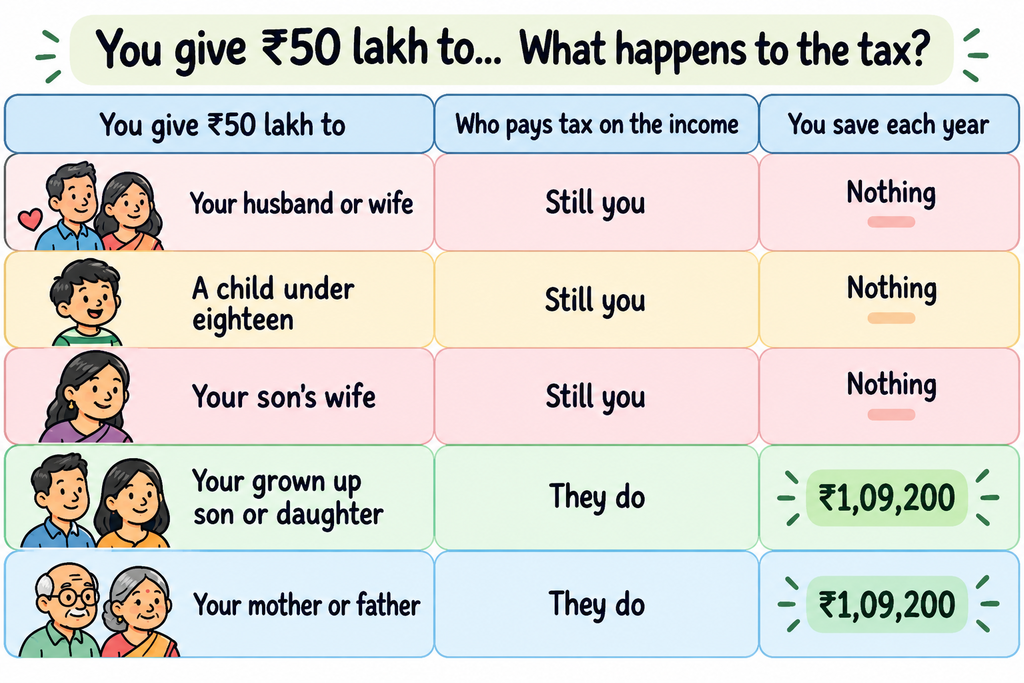
Read the first three rows again. Giving ₹50 lakh to your wife saves you nothing at all. Not a rupee. Most people are certain it does. Grown children and your own parents are different. There the income really does move, and the saving is real.
But only if they earn little
The saving above assumes the person has no income of their own. Once they do, it shrinks fast.

Look at the ₹12,00,000 row. Give to a child earning that and you end up worse off than if you had kept the money.
That is the twelve lakh cliff doing its work. Below ₹12,00,000 their tax is wiped out completely. Your ₹3,50,000 of income pushes them over, and they lose the whole thing at once. The twelve lakh cliff explains why that edge is so sharp. So there is a simple test. Their income plus the income from your gift should stay under ₹12,00,000. On these numbers that means their own income needs to be ₹8,50,000 or less. A retired parent with a small pension is close to perfect. A daughter three years into a good job is close to the worst. When your money is also the family’s money covers the harder question of how much to give at all.
Giving to your wife is slow, not useless
One more thing about that first row, because it is not quite as bad as it looks. The income from the gift comes back to you every year. But it is her money once it arrives. And whatever that money then earns is hers, and does not come back. So a second pile builds up quietly outside the rule. After ten years, nearly half the income is hers and taxed on her. After twenty, close to three quarters of it. It is a slow escape, not a quick one. Worth knowing if you are fifty rather than seventy.
What giving does not reset
Give shares or a flat instead of cash and one thing surprises people later. You pay nothing when you hand it over. Giving is not selling. But they take over the price you paid, and the date you bought it. So when they sell, the gain is counted from what you paid, years ago. The gift did not wipe the slate. The capital gains calculator works out what that costs.
Children living abroad are still close family, so a gift to them is still free. The rules on sending it are a separate matter from the tax.
What could go wrong
- You cannot ask for it back. A gift is final. If you may need the money later, this is not the route, and no paperwork fixes that.
- Money given to a parent follows their will, not yours. It may end up with a sibling. That is often fine, but decide it on purpose rather than by accident.
- Write it down. A short signed note saying who gave what, when, and that nothing was expected back, costs nothing. Years later it is the only proof anyone has. What to do about the money after a death covers the papers families wish they had.
- A gift into a joint account proves nothing. Send it to an account in their name only, from yours. Otherwise it is hard to show whose money it was.
- Do not do it only for the tax. The yearly saving here is about a lakh. Giving away ₹50 lakh you may need at eighty is a much bigger mistake than a tax bill.
What to do with this
- Work out what you will never need. Start with that number, not with who to help.
- Ask what each person already earns. It is an awkward question and it decides the whole thing. Under ₹8,50,000 and the gift works properly.
- Give to grown children or to your parents, not to your wife. For tax, the first two move the income and the third does not.
- Keep gifts from outside the family under ₹50,000 a year. That one is about what you receive, not what you give.
- Tell the family you did it. Quiet gifts to one child are where inheritance fights start.
Giving early is usually the better thing to do. The money arrives when a house deposit or a fee is actually due, instead of thirty years late. Just pick the person with your eyes open. The same ₹50 lakh saves a lakh a year, or nothing at all, depending only on who you hand it to.
This article is for learning. It is not personal tax or legal advice, and no bank, fund or company is named or backed here. The figures use the newer tax regime for the tax year 2026-27 and assume the giver is on the top rate, a gift of ₹50 lakh, and a return of 7% a year. Your own rate and return will give other answers. The small relief for a minor child applies on the older regime only. Who inherits, and whether a gift can be challenged, depend on your religion and on the law that applies to your family. Sending money abroad has its own rules, which are not covered here. Rules change with every Budget. For your own situation, speak to a chartered accountant, and to a lawyer where a will is involved.