

Most budgeting advice assumes your salary is yours. For a lot of people in India, that is not quite true, and it was never going to be. Money moves towards whoever in the family needs it most, and often you are the one it moves away from. This is not a problem to be fixed. It is a fact to be planned around, and almost nobody plans around it.
1. The Budget Line Nobody Writes Down
Open any budget guide and you get the same three buckets. Needs, wants, savings. There is no bucket for the money you send home each month. None for your sister’s college fees, your father’s medicines, or the cousin’s wedding you cannot skip. So it comes out of what is nearest. Usually savings, because savings is the part with no one chasing it. The fix is small and it changes a lot. Give it its own line and its own number. Not because family should be rationed. A number you chose in advance behaves nothing like a number that gets taken.
One useful thing while you are at it. Money you give your parents is not taxed as their income. Gifts between close relatives are exempt in India, whatever the sum. So a monthly transfer home creates no tax problem for anyone.
2. Giving Without a Number
The trouble is rarely the amount. It is that there is no amount. An open ended deal quietly grows. Ten thousand turns into fifteen in a hard month. Then fifteen is the new normal, and no one ever discussed it. Meanwhile you feel guilty about resenting it, and they have no idea it is tight, because you never said.
A stated number helps both sides. Your parents can plan around twelve thousand landing on the third. They cannot plan around what you can spare. Set it up as a standing instruction, on a date just after your pay lands. It stops being a monthly choice, which is just what you want. Raise it when your income rises. Say so when it happens, so the increase is visible rather than absorbed.
3. The Two That Do Real Damage
Steady support, planned for, is fine. Two other things are not. They are the ones that take people years to undo.
Guaranteeing somebody’s loan
This one is badly understood, so it is worth being clear. A guarantor is not a character reference. You owe it just as much as they do. The bank does not have to chase them first, so if the money stops, it can come straight to you. The loan also shows on your own credit report from the day you sign, before anything has gone wrong. Lenders count it against you. Your own home loan gets smaller, or harder to get. If they miss payments, those misses are recorded against your name as though you had missed them. And you cannot just step away later. Coming off a guarantee needs the lender to agree, and often they will not. So treat signing as though you are taking the loan yourself, because in every way that matters to a bank, you are.
Lending what you need back
Money lent inside a family is rarely a loan the way a bank means it. There is no date and no paperwork, and asking for it back is awkward. So the only safe rule is the simplest one. Lend what you can afford never to see again. If it comes back, good. If it does not, you have lost money rather than a relationship, and those are very different losses.
What you must not lend is the emergency fund. That money already has a job.
4. The One Thing You Cannot Borrow For
Here is the catch that decides how this ends.
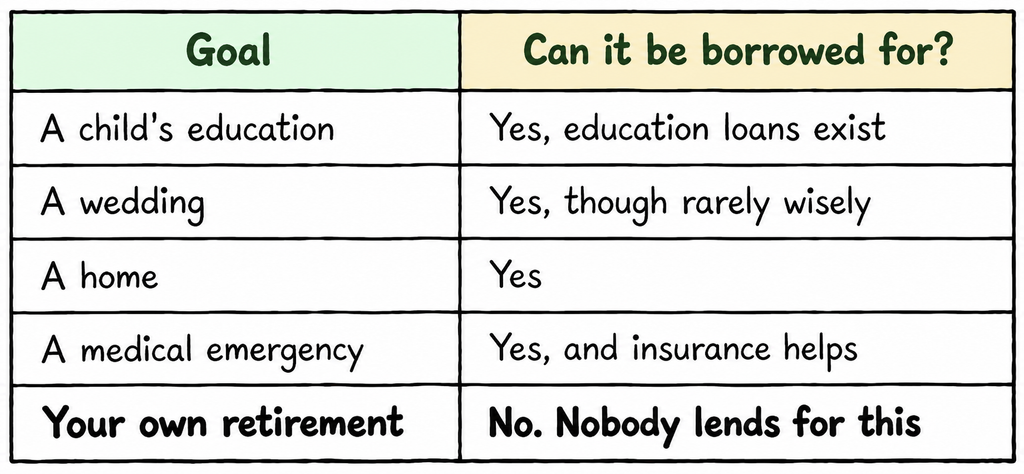
Every line on that list but the last has a lender somewhere. The last one has none. So giving away the money meant for your own old age is not the kind act it feels like. It moves the problem thirty years down the road and hands it to your children. Plenty of people supporting parents today are doing it because those parents made exactly this trade in the nineteen nineties. Funding your own old age is not selfish. It is the one thing you can give your family that no one else can give for you. It is also the only way the cycle stops.
5. Five Things Worth Doing
- Put family support in the budget as its own line. A real number, alongside rent and groceries, not whatever is left.
- Say the number out loud. Vagueness feels kinder and is worse for everyone, including the people receiving it.
- Keep your own retirement money untouchable. Treat it the way you treat rent. It is not the part that flexes.
- Do not guarantee a loan you would not take yourself. If you would not borrow that amount, do not sign for it.
- Get the health cover sorted. Most big family transfers start with a hospital bill. Cover for your parents costs far less than the bill does.
That last one does more than the other four put together. One uninsured hospital stay can undo three years of careful saving. It is the most common reason these plans stop working.
To find the number you can actually commit to, the budget calculator works it out from your pay and your rent. The savings rate calculator shows what protecting your own share does to the year you could stop working. And the health insurance checklist covers cover for parents, which is where most of this actually gets decided.
This article is for learning. It is not personal financial advice, and families differ a great deal. The tax position described for gifts between close relatives, and the rules on guarantor liability, are as they stood in 2026 and can change, so check the current position before acting on either. For advice about your own situation, speak to a SEBI-registered investment adviser, and for anything involving a loan guarantee, take proper legal advice first.