
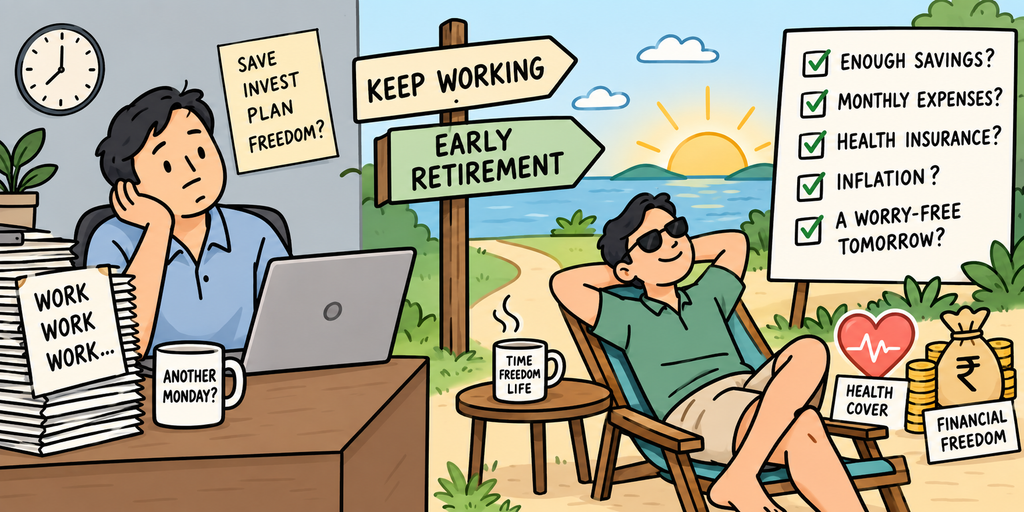
People who plan to stop work early talk about two versions of it. A lean one and a rich one.
The lean version looks clever. You need far less, so you get there far sooner. In India it hides a problem, and the problem is not the one people argue about.
First, the easy question
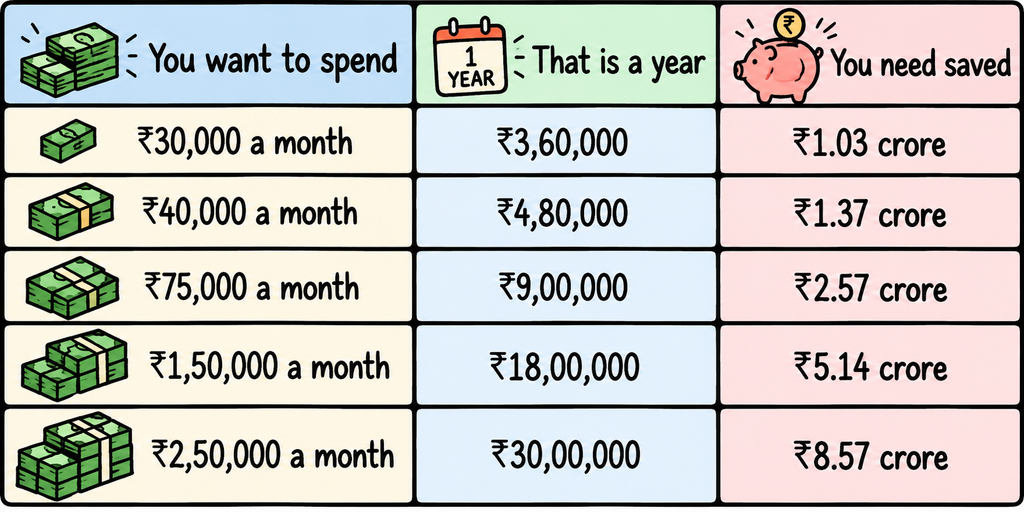
How many times your yearly spending do you need saved? You will hear 25 times. That comes from the West, where prices rise slower. Taking out 3.5% a year is safer here. That is simply 29 times your yearly spending. So the answer is about 29 or 30. That part is settled, and our retirement calculator already works on it.
Here is what that means in money.
Why people pick the lean one
Look at what the choice does to the wait.
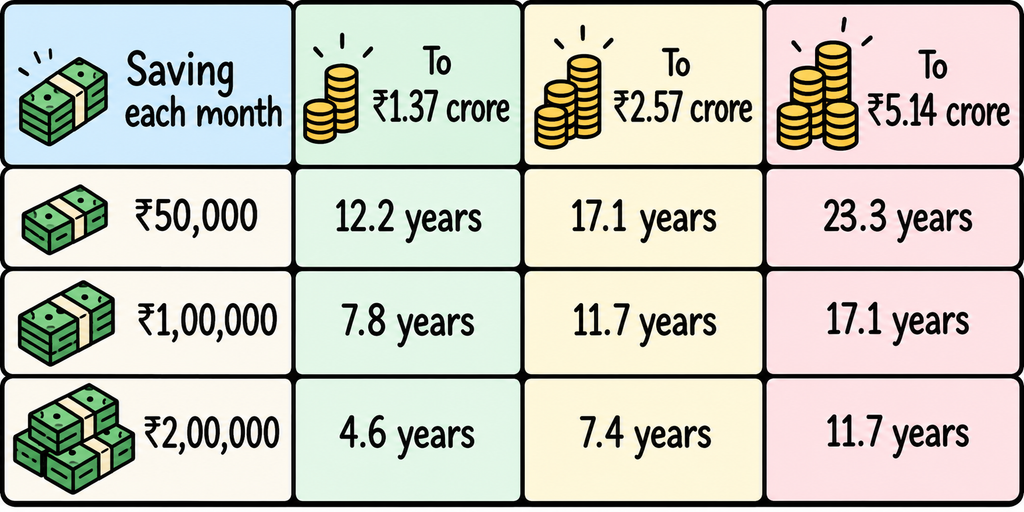
Saving ₹1 lakh a month, the lean plan is done in under eight years. The rich one takes seventeen. Nine years of your life. That is why people go lean, and it is a real reason.
The part no one prices
On the day you stop working, your employer’s health cover stops too. Not at the end of the month. That day. Most people have never bought their own. They have been covered by work for twenty years and have no idea what it costs. It gets worse. Buy a new policy yourself and it can refuse to pay for what you already have. For up to three years. Blood pressure, sugar, a knee. Work cover has no such wait, so you never met this rule before.
There is a way round it, and it has a deadline. You can move your work cover to your own policy and keep the years already served. You have to ask before you leave, not after. Once the cover lapses, the credit is gone and the clock starts again. Sort this out before your last day. A practical checklist for health insurance covers what to look for.
Now the number that decides this
Your spending rises with prices, at say 6% a year. Health cover does not. It rises at about 12%. Medical costs in India climb at roughly twice the rate of everything else. Two numbers growing at different speeds, for forty years. Here is where that ends up.
Start at 45, paying ₹25,000 a year for cover, on the lean plan of ₹40,000 a month.
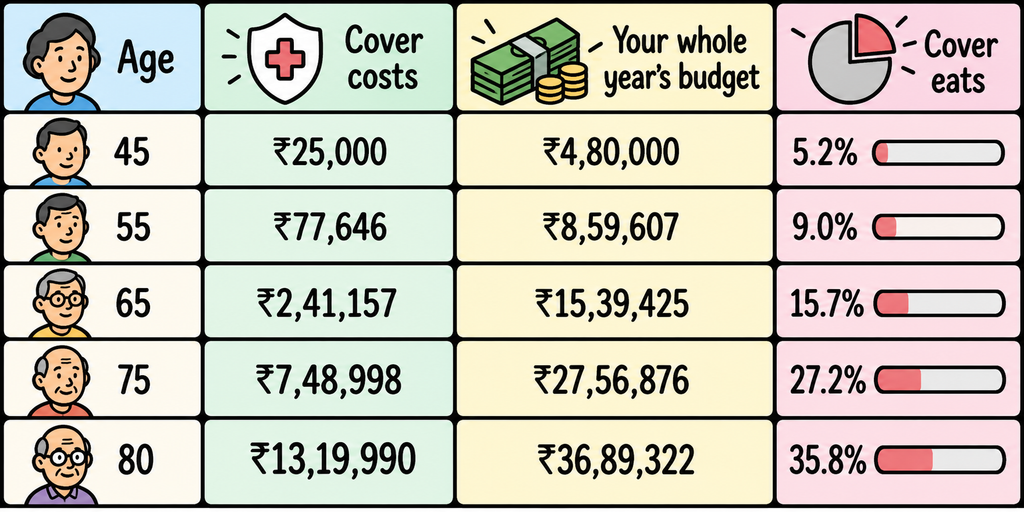
At 45 it is a small line in the budget. At 80 it is more than a third of everything you have to spend. And you still have to eat. Nothing went wrong there. No crash, no illness, no mistake. Just two rates of growth, left alone.
The same bill, on the rich plan
Run the identical cover against a budget of ₹1,50,000 a month.
- At 45 it takes 1.4% of the year’s money.
- At 75, 7.2%.
- At 80, 9.5%.
Same policy. Same rise. It ends at 9.5% of one budget and 35.8% of the other. This is the real difference between the two plans. It has nothing to do with holidays or cars. A bigger budget absorbs a fast rising cost. A lean one cannot, because there is nothing in it to cut.
And one bad year
Say a ₹10,00,000 bill lands in year three. A bill cover did not fully pay for.
- Lean plan, ₹1.37 crore saved: that is 7.3% of everything.
- Middle plan, ₹2.57 crore: 3.9%.
- Rich plan, ₹5.14 crore: 1.9%.
You have forty years to go. Taking 7% out in year three is not a setback. It is the end of the plan. And selling while markets are down makes it worse, which the three bucket approach explains.
So what does lean really mean
It does not mean a simpler life. It means no room. A lean plan works while nothing happens. It assumes your health holds. That your parents need no help. That your child’s plans stay cheap. That no one in the family has a bad year. Over forty years, something happens. That is what forty years is.
There is also a quieter point. Every extra ₹5,000 a month of spending needs another ₹17 lakh saved, at any level. Cutting your plan to the bone saves years of work. It also removes your only margin. Going back to work at 60 is much harder than not stopping at 45.
What to do instead
- Price your own health cover today. Not a guess. Get a real quote for your age and your family. Most people find it is two or three times what they assumed.
- Move your work cover to your own name before your last day. This is the single most valuable thing on this page, and it has a deadline you only get once.
- Budget health separately, and grow it faster. Put the rest of your spending up 6% a year and this one up 12%. It is the only line that behaves differently.
- Do not aim at the bare number. Whatever your 29 times works out to, treat it as the floor. Aim past it. The years you spend getting past it are the cheapest insurance you will ever buy.
- Keep a way to earn. Part time, consulting, anything. Not because you must. A plan with no income at all has to be right about forty years. Leaving a job on purpose covers how that gap behaves.
- Check the real number for your own spending. The savings rate calculator turns your saving share into a number of years.
Stopping work early is a fine goal and the maths of it is not hard. Twenty nine times your spending, saved.
The trap is picking a small spending number so the target comes sooner. Then living forty years inside a plan built for a good decade.
This article is for learning. It is not personal financial advice, and no insurer, fund or company is named or backed here. The figures use a 3.5% yearly withdrawal. General inflation is 6%, medical inflation 12%, and growth while saving 10%. Each one is an assumption chosen to show how the sums behave. None is a forecast, and markets can fall. Reported medical inflation in India runs at roughly 11% to 13% and changes. Cover premiums depend on your age, city, family and health. Get your own quote. Waiting periods for existing conditions can change. So can the rules for moving an employer policy to your own name. Both are set by the insurer within the regulator’s rules. Confirm them before you resign. For advice about your own situation, speak to a SEBI-registered investment adviser.