
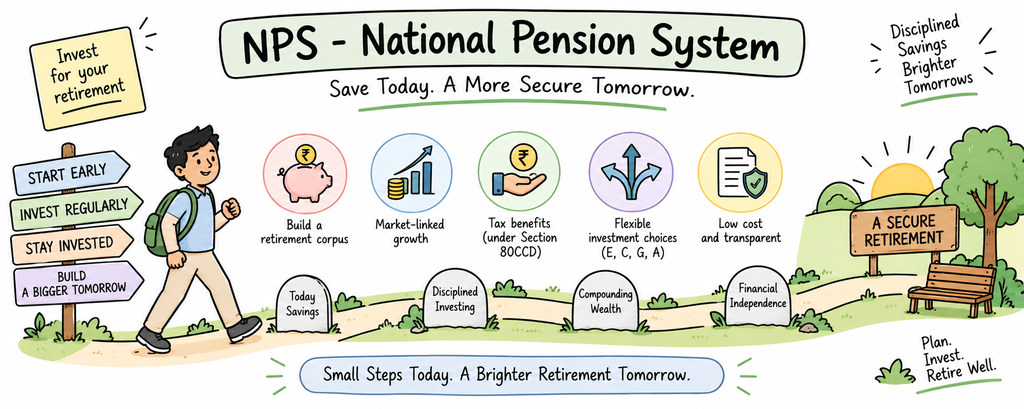
The National Pension System is usually sold on three tax advantages. Money going in is deductible, it grows without being taxed along the way, and a large part comes out tax free at the end.
Two of those three have changed in the last couple of years. Most of what you will read about NPS still describes the older version, and the gap between the two is worth lakhs. This is what is actually left.
The first change: the deduction mostly went away
For years NPS was recommended for one reason above all others. It had a deduction slot of its own, on top of the usual limit, for money you put in yourself.
That slot still exists, but only on the older tax regime. The newer regime is now the default, and if you have never filled in a form to choose, you are on it. On the newer regime, money you put into NPS out of your own pocket saves you nothing at all.
What survives on both is your employer’s contribution. That is the part still worth having, and it is worked through properly in the NPS calculator. If you are not sure which regime you are on, start with old regime or new regime.
The second change: you can now take more out
The old rule was the one everybody complains about. At sixty you could take 60% of your money as cash, and the other 40% had to buy an annuity, a monthly income for life, at whatever rate was available on that day.
The regulator has loosened that. For most private subscribers the lump sum is now up to 80%, and only 20% has to buy an annuity. There are conditions.
- You need at least fifteen years in the scheme for a normal exit.
- If your total is ₹8 lakh or less, you can take all of it in cash and buy no annuity at all.
- Between ₹8 lakh and ₹12 lakh, there are limits on how much comes out as a single payment.
- Above ₹12 lakh, the 80 and 20 split applies.
On the face of it this is straightforwardly good news. More of your own money, less of it locked into a product you did not choose.
The catch almost nobody mentions
The regulator changed the rule. The tax law did not follow.
The exemption that makes your lump sum tax free still stops at 60% of the total. So you may now withdraw 80%, but only 60% of it comes out free of tax. The extra fifth is added to your income in the year you take it and taxed at your slab rate.
Put numbers on it. Say you put ₹10,000 a month into NPS for thirty years and it grows at 11% a year before charges. You reach about ₹2.78 crore.
- The regulator lets you take 80%, which is ₹2.22 crore.
- The tax law exempts 60%, which is ₹1.67 crore.
- That leaves ₹55.5 lakh taxable, in one year, on top of whatever else you earn.
At a 30% slab with cess that is about ₹17.3 lakh of tax on money you had been told was tax free. At a 20% slab it is about ₹11.5 lakh.
This may well be fixed in a future Budget. It has not been fixed yet. Until it is, taking the full 80% is a decision with a price attached, and the person selling you NPS today is unlikely to mention it.
So what is actually left worth having?
The cost. This is the part of the case for NPS that has not been chipped away, and it is real.
NPS fund management charges are capped at about 0.09% a year. That is among the lowest anywhere in the world for a managed fund, and far below what most Indian funds charge. Small differences in charges do serious damage over thirty years, so this matters.
But it matters by a lot less than the sales pitch implies, and the honest comparison depends entirely on what you are comparing it with. Same ₹10,000 a month, same thirty years, same 11% before charges.
- NPS at 0.09%: ₹2.78 crore.
- A cheap index fund at 0.20%: ₹2.71 crore. NPS is ahead by ₹6.58 lakh, which is 2.4% of the total.
- A typical actively managed fund at 1.25%: ₹2.16 crore. NPS is ahead by ₹61.4 lakh, which is 22%.
Read those two gaps side by side, because they tell you the whole story. Against an expensive actively managed fund, the low charge is genuinely powerful. Against a cheap index fund you could buy this afternoon with no lock in at all, the entire advantage is a little over two per cent spread across thirty years.
That is not nothing. It is also not a reason to lock money up until you are sixty.
What you give up for it
Three things, and they are the reason NPS is not simply a better index fund.
- It is locked until you are sixty. Not discouraged. Locked, with narrow exceptions. Money you might need at forty five for a medical emergency or a business or a job loss should not be in here.
- Part of it must buy an annuity. On that ₹2.78 crore, ₹55.5 lakh has to be handed over for a monthly income, at whatever rates exist on the day you turn sixty. You do not get to wait for a better year.
- The annuity income is taxed as ordinary income, for life. Not at the gentler rates that apply to investment gains. At your slab, every year, for as long as you live.
On the annuity itself, one detail worth knowing before you are standing in front of the form. The rate you are quoted depends on what happens to your money when you die. An annuity that returns your capital to your family pays around 6% a year. One that does not pays around 7.5%. On ₹55.5 lakh that is roughly ₹27,750 a month against ₹34,700 a month. The higher number is not a better deal. It is the same deal with your family’s inheritance removed.
Who it still suits
- Anyone whose employer contributes. This is the clearest case by far. It comes out of your total salary either way, and routed through NPS it is not taxed now. Take it.
- People still on the older regime who have filled the usual limit and want another deduction slot.
- People who know they will otherwise spend it. The lock in is a real feature if your honest problem is that retirement money does not survive contact with you. Paying a small price for a door you cannot open is a legitimate choice.
Who should think harder
- Anyone on the newer regime putting in their own money for the tax break. There is no tax break on that money any more. If you are still doing it out of habit, you are choosing a thirty year lock in for a charge saving of about two per cent against a fund you could sell tomorrow.
- Anyone who might need the money before sixty. Build the emergency fund and clear expensive debt first. Both beat this.
- Anyone counting on taking the full 80% tax free. On today’s rules you cannot.
None of this makes NPS a bad product. It is cheap, it is well run, and the employer route is one of the better deals available to a salaried person in India. It is simply no longer the thing it is still being sold as, and the difference matters most to the people who were sold it hardest.
Put your own salary into the NPS calculator and it will show you what you actually save, on both regimes, and what your money looks like at sixty.
This article is for learning. It is not personal financial or tax advice. It describes the position for a private sector subscriber in the 2026-27 tax year, after the exit rules were amended to allow a larger lump sum. Rules for government subscribers differ. The growth rates and charges used are examples chosen to show how the sums work, not forecasts, and annuity rates change constantly. The mismatch between the withdrawal limit and the tax exemption described above is the position today and may be changed in a future Budget, so check before you act. For advice about your own situation, speak to a qualified tax professional or a SEBI-registered investment adviser.