
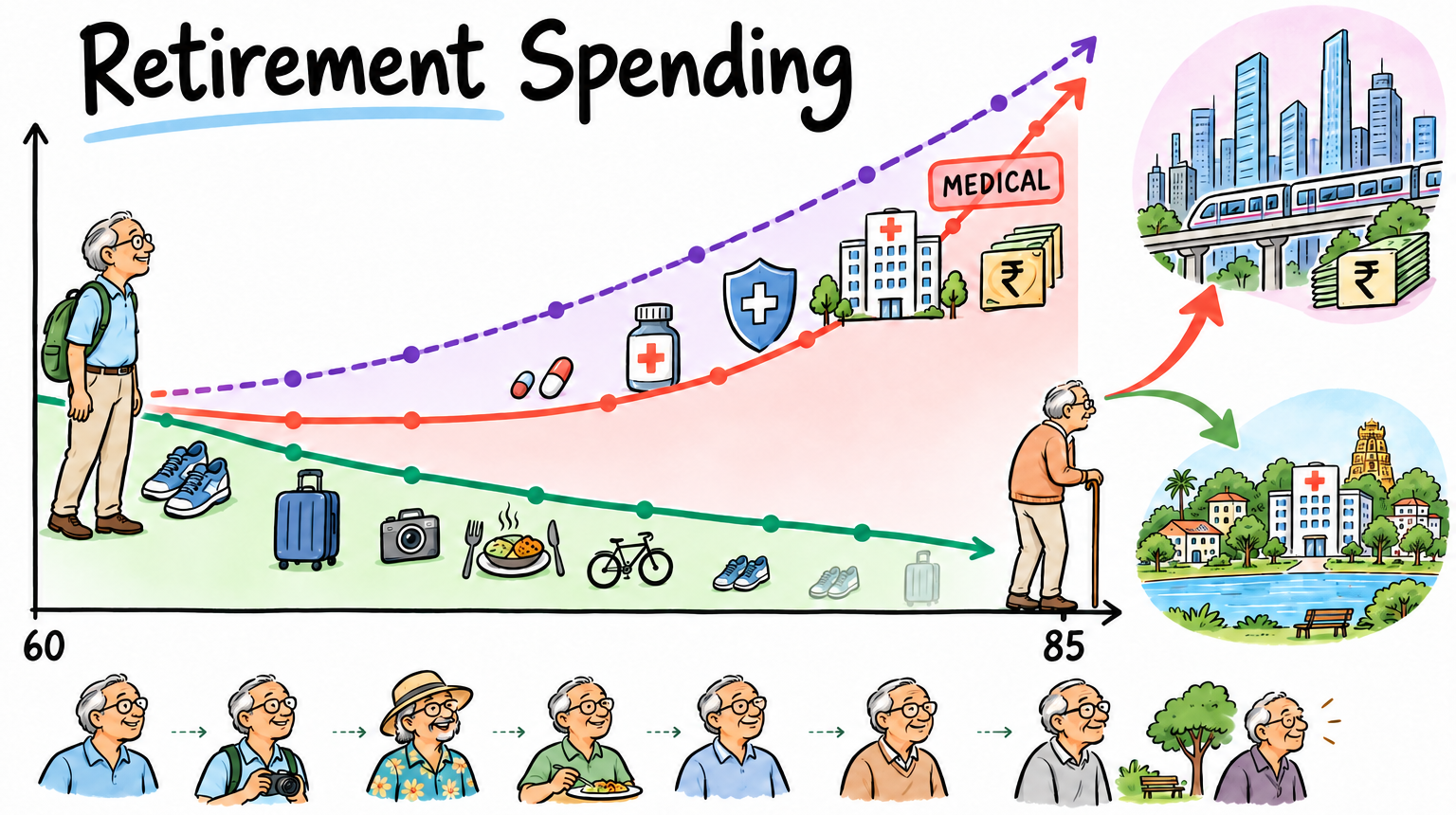
There is a well known finding in retirement research. People spend less as they get older. Not because they run out, but because they slow down.
If that holds, every retirement number you have ever been given is too large, including the ones on this site. So it is worth checking properly rather than hoping.
What the research actually found
Retirement tends to arrive in three phases. The active years, when there is travel and there are weddings. Then quieter years. Then the years when you mostly stay home.
Spending follows. The research puts the fall at roughly 1% a year in real terms, which compounds into a large difference over twenty five years. Importantly, it happens even among retirees who could easily afford to spend more. They simply choose not to.
The “smile” is what happens at the end. Spending falls for years, then curls back up late in life as medical costs arrive. Drawn on a chart, it looks like a smile.
Two reasons to be careful with it
The first is that researchers do not agree on the smile. Some find the upward curl at the end. Others find spending simply keeps falling, with no curl at all. The difference seems to be that big medical bills hit some retirees hard and miss others entirely, which moves the average without moving the typical case.
The second reason matters more. All of this is American data.
An American retiree gets government health cover from sixty five. An Indian one does not. And in India, medical costs are rising at about 13% a year, roughly three times general inflation, among the fastest anywhere in Asia. Close to 40% of health spending here comes straight out of household savings.
So the question is not whether Indians also slow down. They do. The question is whether slowing down is enough to outrun that 13%.
The answer, in one table
Take someone retiring at sixty on ₹60,000 a month, of which ₹8,000 is medical. General prices rise 6% a year, medical 13%.
Now be generous to the research. Apply the full 1% a year real decline to everything except the medical part. Here is what the month costs, converted back into today’s money so it is comparable.
- At 60: ₹60,000. Medical is 13% of it.
- At 70: ₹62,192.
- At 80: ₹71,275.
- At 85: ₹80,020. Medical is now 49% of it.
Read that again, because it is the point of the whole article. Even with the full slowdown the research describes, the cost of your month in real terms still goes up. It rises by a third by the time you are eighty five.
The spending smile is real. In India it is drowned out by one line of the budget.
What that means for your number
It means you should keep planning on steady spending, which is exactly what the retirement calculator assumes. That assumption is often called conservative. In India it is closer to accurate.
Treat any slowdown as a cushion you might get, not a discount you can bank. Plans built on the discount fail at eighty five, which is the worst possible moment to find out.
The lever that does work
There is one change that reliably cuts the number, and unlike the spending smile it is a decision rather than something that happens to you. Where you live.
Living costs in smaller Indian cities run roughly 40% to 50% below the big metros, with housing 40% to 60% lower. That is a large enough gap to change the whole plan.
- ₹60,000 a month in a metro needs savings of about ₹2.06 crore, drawing 3.5% a year.
- ₹36,000 a month in a smaller city needs about ₹1.23 crore.
That gap is ₹82 lakh. For somebody putting away ₹12.5 lakh a year, it is about seven years of saving. There is no fund selection, no clever product and no market return that does what one change of address does.
And the catch on that lever
It is a real one, and it is the same 13% again.
The whole reason your late retirement gets expensive is medical care. Moving somewhere cheaper often means moving away from the hospitals you would want at eighty, at precisely the point when medical is heading towards half of your spending.
So the test for a retirement town is not the rent. It is whether there is a hospital you would be content to be admitted to at two in the morning, and whether your insurer has an arrangement with it so you are not paying the bill yourself and claiming it back later.
Check the hospital before the apartment. Plenty of smaller Indian cities pass that test comfortably. Some do not, and the ones that do not are often the cheapest.
What to do with all this
- Keep planning on steady spending. Do not reduce your target because of research carried out somewhere with public health cover.
- Model medical separately from everything else. One inflation rate for the whole budget hides the only line that actually behaves badly.
- Get your health cover sorted long before you need it. Premiums rise with age and with medical inflation, and waiting periods mean cover bought late is cover that does not work yet. The health insurance checklist covers what to look for.
- If the city move appeals, try it before you commit. Spend a few months there first. It is easier to move at sixty than at seventy five, and much easier than moving back.
- Keep the growing part growing. A retirement that gets more expensive in real terms cannot be funded entirely from deposits, which is the argument the three bucket approach makes at greater length.
The cheerful version of this article would have told you your retirement is cheaper than you feared. The honest version is that the slowdown is real, it is just not big enough, and the thing you can actually control is a decision about where to live rather than a hope about how much you will feel like doing at eighty.
This article is for learning. It is not personal financial advice. The spending decline described comes from research on American retirees and is contested even there; no comparable Indian study is used here, and that gap is the reason the article reaches a cautious conclusion. Medical inflation, general inflation, city cost differences and the withdrawal rate used are all estimates that change and that will differ for you. The figures are illustrations chosen to show how the sums work, not forecasts. For advice about your own retirement, speak to a SEBI-registered investment adviser.