
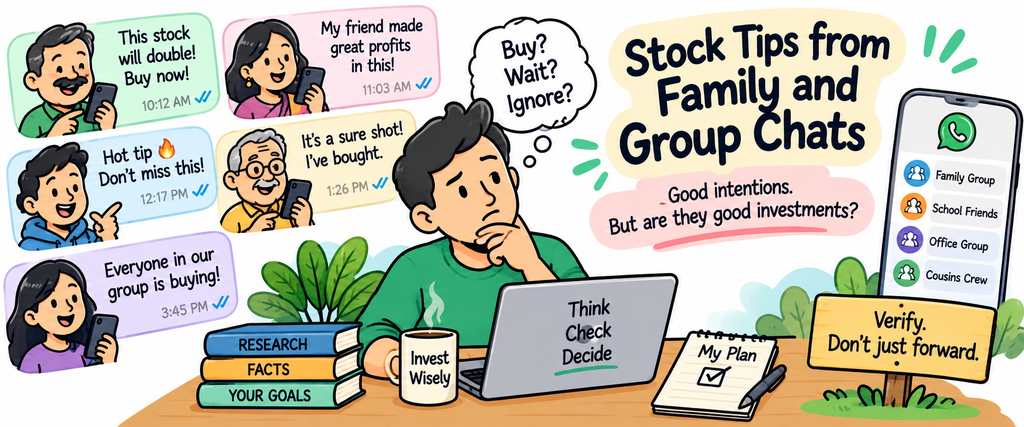
It usually starts at a family lunch, or in a group chat, or on the walk back from a kitty party. Someone mentions a share. They are doing well out of it. There is a reason it is going to keep going, and the reason sounds solid.
And you are not careless with money. You have a SIP. You know you are supposed to be patient. But this feels different. This is not a stranger on television. This is your cousin, or your neighbour. Or a group chat where twenty people seem to be making money every week, while your own investments plod along and you feel slow.
So let us talk about what is actually happening in those conversations. Not to tell you off. Most people who lose money this way were being sensible everywhere else in their lives.
Where the tip comes from
Here is the uncomfortable question. Your cousin told you. But who told your cousin?
Follow that chain back far enough and quite often you reach someone who is not passing on good news at all. They are selling. And for them to sell a large quantity at a good price, a lot of people like you have to be buying at the same time.
That is the whole trick, and it has a name. People call it pump and dump. It works like this.
- First they buy quietly. They pick a small company whose shares do not trade much. In a small company it does not take a lot of money to move the price, which is exactly why it was chosen.
- Then they start talking. Messages go out across channels and groups. Big numbers, big words. A story about a new order, a new plant, a new buyer.
- The price rises, which proves the story. This is the clever part. The rise is caused by the messages, but to anybody watching it looks like proof that the messages were right.
- More people arrive. Including you, because now it is not just a tip, it is a tip that is clearly working.
- They sell into your buying. Quietly, the way they bought. The messages stop. The price falls back to roughly where it was.
No one has to be lying for this to work on you, by the way. Your cousin genuinely believes it. He is not in on anything. He is somewhere in the middle of the chain, which is the most convincing place to hear it from.
This is not a theory
In 2026 SEBI barred seven people from the securities market for running exactly this. They bought the shares first. Then they promoted them, through social media accounts with more than fifty four thousand followers between them. Then they sold, once enough people had arrived.
It covered 82 different companies. The money they made out of it was put at ₹20.25 crore. Now think about where that ₹20.25 crore came from. It was not created. It was paid, in ordinary amounts, by ordinary people who bought because the price was rising and someone they half trusted was excited.
SEBI also described the language used in the messages. Words like record breaking, new highs, multibagger. If you have been in one of these groups, you have read those words this month.
Why this works on sensible people
This is the part worth spending time on, because it is the part that decides whether you buy or not.
You already know that stock tips are a bad idea. Everybody knows that. Knowing it does not help, because the tip does not arrive looking like a stock tip. It arrives looking like five other things, each of which you are right to trust in ordinary life.
- It came from a person, not from an advertisement. You have spent your whole life learning to ignore advertisements and listen to people you know. That is a good rule. It is also the opening. A message from your brother in law does not get checked the way an advertisement gets checked.
- Several people are saying the same thing. Twenty people agreeing is normally strong evidence. But in a group chat it is not twenty opinions. It is one source, repeated twenty times, and you cannot see that from inside the group.
- The price is doing what they said it would. This is the strongest one. The share went up, just as promised, and that feels like proof. It is not proof. The buying is what moved the price, so you are watching the crowd arrive, not the company improve.
- You only ever see the wins. People post the profit screenshots. No one posts the losses. So the group looks like a room full of winners, when it is really a room full of people showing their best day and staying quiet about the rest. You end up comparing your real record against everyone else’s highlights.
- Not buying feels like a decision too. If it goes up and you stayed out, you will hear about it at the next lunch. That small social cost is immediate and certain, while the risk of loss is vague and later. Most of us pick the certain comfort.
None of that is stupidity. Every one of those instincts is useful in normal life. They are being used against you here, which is a different thing entirely.
Why you always hear about it late
Here is something worth sitting with for a moment. By the time a tip reaches you, how far has the price already moved? It has to have moved. That is what made it worth talking about. No one gets excited about a share that has done nothing. The story only becomes a story after the price starts rising. Which means you are almost never early. You are buying after the move. So the real question is simple. What happens to you if the price just goes back to where it started?
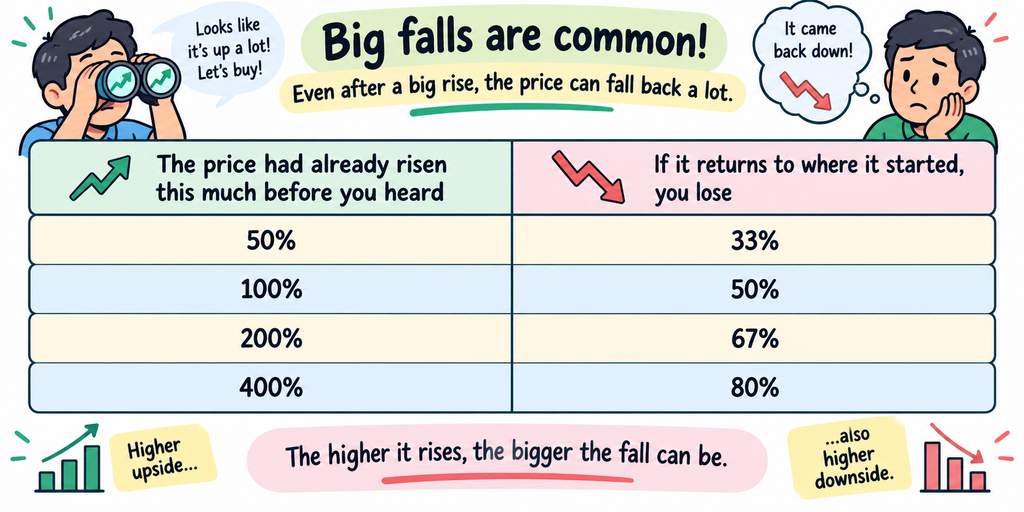
Read the second row again. If the price had doubled before the tip got to you, and it goes back to normal, you do not lose a little. You lose half. And nothing unusual has to happen for that. The company does not have to fail. There is no fraud, no bad quarter, no scandal. The price just has to stop being pushed.
The bit of arithmetic no one expects
Most people assume that if something falls 50%, it needs to rise 50% to get back. That feels right. It is wrong, and the gap between those two feelings is where a lot of money quietly disappears. If you have ₹100 and it falls by half, you have ₹50. For ₹50 to become ₹100 again, it has to double. It has to rise 100%, not 50%. The further it falls, the worse this gets, and it gets worse very quickly.

That last column is the one that should stop you. It is asking how long the share would need to grow at a perfectly good rate, year after year, just to bring you back to the price you paid. Twenty five years to get back to level. Not to make anything. To get back.
So is this worse than a market crash?
You would think not. A crash sounds far more frightening. It takes everything you own and cuts it, all on the same day. And it is on every news channel while it happens. A tip only takes the small amount you put into it. So surely the crash is worse? Let us actually compare them. Say you have ₹20 lakh invested and you are twenty five years from needing it.
The crash. The whole market falls 38%, which is roughly what happened in early 2020. Your ₹20 lakh becomes ₹12,40,000. That is a horrible thing to look at, and plenty of people sold at exactly that moment. But if you did nothing at all, the market recovered, and so did you. Your twenty five year goal did not move. The cost of that crash, to the thing you were actually saving for, was nothing.
The tip. Now instead you put ₹4 lakh of that same ₹20 lakh into shares people told you about. One fifth of what you had. They fall 70%, which is ordinary for this kind of thing. You have lost ₹2,80,000. Smaller than the crash, obviously. The rest of your money is untouched. So why is this the worse outcome? Because this money is not coming back. The market recovers because it is made of hundreds of companies and the economy grows. One small company that was pushed up and then abandoned has no such engine. Nothing is pulling it back.
And that ₹2,80,000 was not going to sit still for twenty five years. It was going to grow. Had it stayed where it was, it would have become ₹30,33,718 by the time you needed it.
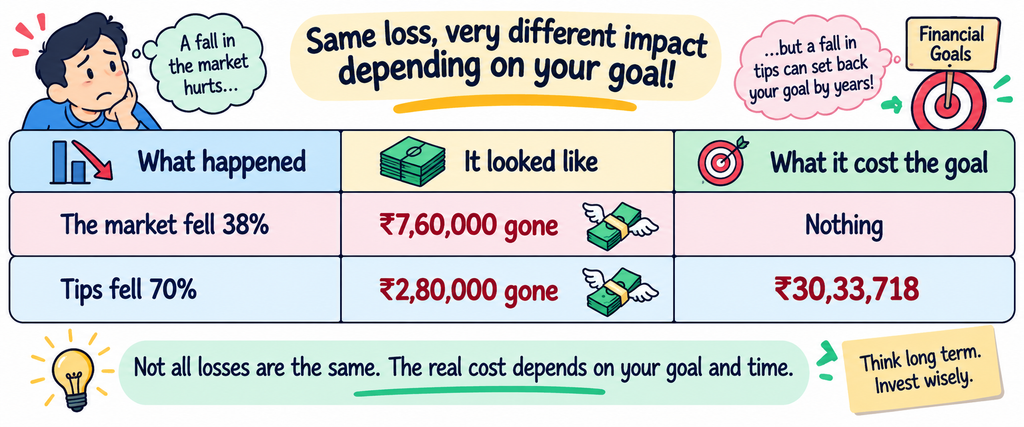
So yes. The small loss was the expensive one, and it was not close. A crash borrows your money and gives it back. A bad tip takes it.
What any loss really costs you
That is worth generalising, because it applies to every rupee you lose permanently, at any age.
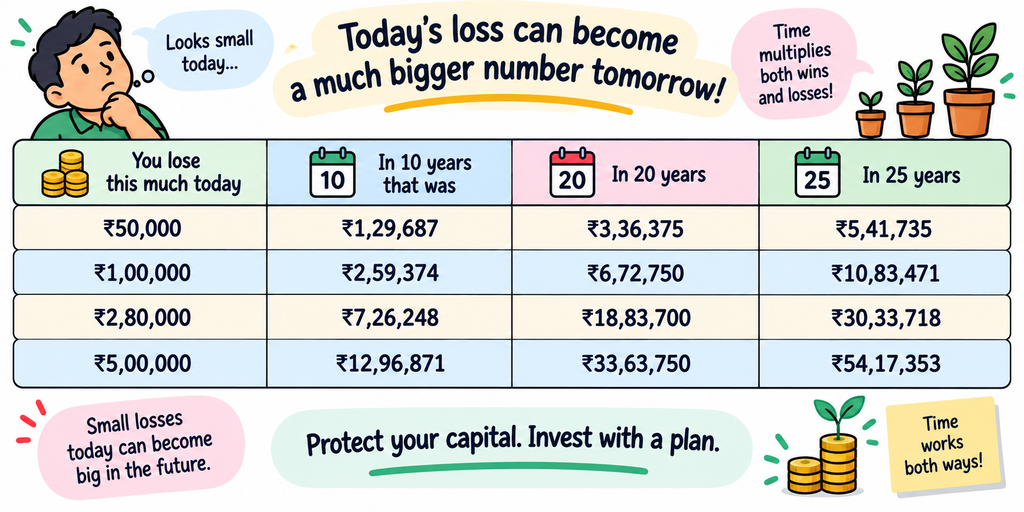
A fifty thousand rupee mistake at thirty five is a five lakh rupee hole at sixty. That is the real price of one afternoon of being convinced.
But my friend did make money
He probably did. This is the hardest part of the whole subject, so let us not pretend otherwise. Some people make money on tips. Someone has to be holding when the price is high. If no one ever won, the groups would have emptied years ago.
Two things are worth knowing about those winners.
The first is that you hear about them. You do not hear about the losses. You can win most trades and still lose money shows how that works even for people keeping proper records. No one comes to a family lunch and announces that he is down 70% on something his broker never recommended. The group chat is full of profit screenshots for the same reason. The result is that everyone is comparing their own real record against everybody else’s best day.
The second is that winning once is the dangerous outcome, not the good one. It teaches you that this works. The next time the amount is larger, because last time was too timid. The amount keeps growing until one of them does not come back, and the one that does not come back is always the biggest.
You are already holding one. Now what?
Plenty of people reading this are not deciding whether to buy. They bought eight months ago, it is well down, and they have been waiting. So let us deal with that properly, because the waiting itself causes most of the damage. The sentence that keeps people stuck is this one. I will sell when it gets back to what I paid. It sounds responsible. It is the most expensive sentence in investing, for one simple reason. The share does not know what you paid. Your purchase price is a fact about you. It is not a fact about the company, and nothing in the market is working to bring the price back to it.
Here is the only question that actually helps. If you had that money in your hand today, in cash, would you buy this share at today’s price? If the answer is yes, then hold it, and hold it for your own reasons rather than because of a group chat. If the answer is no, then you are not really investing in it any more. You are holding it because selling would make the loss feel real, and holding lets it stay a maybe. That feeling is worth money, and this is what it is costing you.
Please do not buy more of it
There is one move people make at this point that deserves its own warning, because the arithmetic genuinely does look like it helps. You hold ₹1,00,000 of something that is now worth ₹50,000. Buying more at the lower price brings your average cost down. People call it averaging down, and here is what it does. Put in another ₹1,00,000. You have now spent ₹2,00,000 and you hold ₹1,50,000 of shares. The price now only needs to rise 33% to get you level, instead of 100%.
That is true. It really is easier to get level. This is why the move is so tempting, and why sensible people do it. But look at the other number. Your money at risk in this one share has gone from ₹1,00,000 to ₹2,00,000. You have doubled your bet on the thing that has already gone wrong, in exchange for an easier path back to zero. Getting level is not the goal. Getting level is just the number that happens to be stuck in your head.
If you do sell, the loss is worth something
One small piece of good news, and most people miss it entirely. A loss you have actually booked can be set against gains you made elsewhere, which reduces the tax you pay on those gains. A loss you are still sitting on does nothing for you at all. So a booked loss of ₹1,00,000, set against a long term equity gain, saves you about ₹13,000 of tax. It is not a rescue. But it is real money, and you only get it if you stop waiting.
There are rules about which losses can meet which gains, and about filing on time. Tax harvesting covers them, and the capital gains calculator will work out your own position.
Saying no without starting a fight
Here is the part the money articles usually skip, and it is the part that actually decides what you do. The tip did not come from a website. It came from your sister in law, in front of other people, and she was being generous. She thinks she is helping you. In many families, saying no to that is not a financial decision at all. It is a social one. So do not argue about the share. You will not win, and there is nothing to win.
A few things that work better than arguing:
- Make it about your rule, not about their share. You do not buy single shares, as a rule, whoever suggests them. A rule is not an insult. Disagreeing with their particular share is.
- Be pleased for them. If it is doing well, say so and mean it. Nothing about your decision requires them to be wrong.
- Do not announce that you are not buying. You do not owe anyone a public answer. Thank them, take the name, and do nothing about it.
- If it goes up, do not revisit it. It will sometimes go up. You made a decision about risk, not a prediction about price, and those are different things.
Family money pressure is its own subject, and it is bigger than shares. When your money is also the family’s money goes into it properly.
One check that takes two minutes
Here is something concrete you can do, and it is easier than people expect. In India, anyone who advises you about shares for a fee has to be registered with SEBI. That is not a formality. A registered adviser has to be qualified, has to tell you how they are paid, and has to put your interest first. If they do you harm, there is somewhere to complain. Someone running a tips channel has none of that. No qualification to hold, no duty to you, and nowhere for you to go afterwards.
You can check anyone in a couple of minutes. Go to SEBI’s own website, open the list of registered intermediaries, and look under investment advisers. If the person charging you for tips is not on that list, they are not allowed to be charging you for tips. It is a fair question to ask directly, too. A genuine adviser will give you their registration number without being offended by the question. And some things in a message should end the conversation on their own. A promised return. A target price with a date attached. Pressure to act today. A reason you must not tell anyone. No one who actually knows something tells five thousand strangers about it for free.
What could go wrong
- Deciding you will just be quick. The plan is always to take the gain and leave before the fall. Everyone in the group has that plan, which is the problem with it.
- Treating a free tip as free. If no one is charging you, ask what the person gains from you buying. Sometimes the answer is nothing. Sometimes the answer is the entire point.
- Confusing a small company with a cheap one. A share priced at ₹14 is not a bargain. The price tells you nothing about value, only about how the shares were divided up. The jargon buster explains that one in plain words.
- Letting it become a habit before it becomes a loss. By the time the big one arrives, you will have done this many times without harm. That is exactly why the amount will be large.
- Thinking this is about intelligence. It is not. It works on doctors and engineers and accountants, because it is built on trusting people, which is otherwise a good habit.
What to do with this
- When a tip arrives, ask how far the price has already moved. One look at a one year chart answers it. If it has already doubled, you are the buyer someone else needed.
- Ask who told them. Not to be rude. Just follow it back two steps and see whether anyone can name a source that is not another group.
- Check the registration before you pay anyone for advice. Two minutes, on SEBI’s own site, before any money changes hands.
- If you are already holding one, ask the cash question. Would you buy it today at today’s price? Answer honestly, then act on your answer.
- If you still want to do it, cap it and write the cap down. Some people will do this whatever anyone says. A fixed small amount that never grows is far better than pretending you will not. Keep it well away from money that has a goal attached, which the asset allocation calculator can help you separate.
- Leave the kitty party conversation alone. You do not have to argue with your cousin. You just do not have to buy.
The boring money is still working while all this is going on. Your SIP does not need a group chat. It does not need you to be clever this month. If you are early in all this, before your first investment covers what to put in place first.
That is genuinely the whole advantage. Not that you are smarter than the people in the group. Only that you are still holding your money at the end of it.
This article is for learning. It is not investment advice, and no share, company, group or channel is named or recommended here. The recovery figures are arithmetic and hold in every case. The comparison with a crash uses these figures. ₹20 lakh invested. A fall of 38% in the whole market. A fifth of the money put into shares that then fall 70%. Growth of 10% a year over 25 years, which is the rate used across this site. Markets may behave differently, past recoveries are not a promise of future ones, and a single company can fall and never recover. The tax saving shown assumes a long term equity gain taxed at 12.5% plus cess, and the rules on setting losses against gains have conditions, including filing your return on time. The SEBI case described was decided in 2026. For advice about your own money, speak to an investment adviser registered with SEBI.