
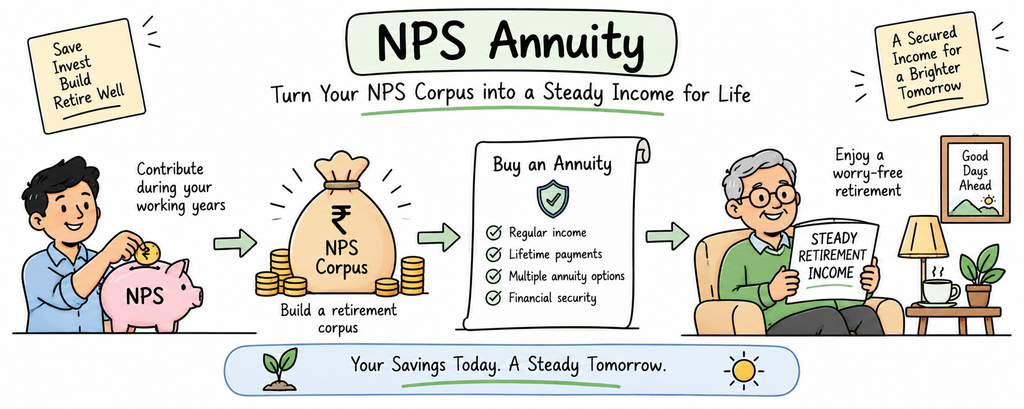
At sixty, 20% of your NPS savings has to be handed over to an insurance company in exchange for a monthly income for the rest of your life. You cannot skip it, and once it is done it cannot be undone.
Most people sign whatever form is put in front of them. It is a one time, permanent choice between five quite different options, made on a single day, and nobody explains the difference. This is what you are actually buying.
What an annuity is
You give an insurance company a lump sum. They pay you a fixed amount every month until you die.
The thing they are selling you is not growth. It is certainty. If you live to ninety five they keep paying, long after your own money would have run out. That is the product. Everything else follows from it, including why the monthly figure looks lower than you hoped.
Throughout this article the example is the one from what is left of NPS after the rule changes: about ₹55.5 lakh going into the annuity.
The five options, and what each one costs
Same money, very different outcomes. Roughly, on rates available in India at the moment:
- For your life only. Around 7.5%, so about ₹34,700 a month. Highest income. When you die the payments stop and the money is gone. Nothing for anyone else.
- Joint life. Around 7%, so about ₹32,400 a month. Payments continue to your spouse after you die, at a full or reduced rate depending on the plan.
- With your money returned. Around 6%, so about ₹27,750 a month. Lowest income, but the whole ₹55.5 lakh goes to your nominee when you die.
- Guaranteed for a set number of years. Pays for five, ten, fifteen or twenty years whatever happens, then for life. Useful if you are worried about dying early.
- Rising each year. Starts lower, then increases by a fixed amount, often 3% a year.
Look at the first and third. The difference between them is about ₹7,000 a month, every month, for the rest of your life. That is what leaving the money to your family costs. It might be well worth it. It is not free, and nobody says so out loud.
The problem nobody points at
The payment is fixed. Your costs are not.
Take the ₹27,750 a month. It never changes. Here is what it will actually buy, if prices rise 6% a year.
- After 10 years it buys what ₹15,495 buys today.
- After 15 years, what ₹11,579 buys today.
- After 25 years, what ₹6,466 buys today.
It halves in about twelve years at 6%, or fourteen years at 5%. If you retire at sixty and live to eighty five, the pension that felt reasonable on your last day of work is worth under a quarter of that by the end, in a period of your life when medical costs are climbing fastest.
This is the same problem covered in the price you planned for is not the price you will pay, except here you have signed away the ability to do anything about it.
So is it a bad deal?
Not exactly, and it is worth being fair about this rather than just alarming.
Take the version where your money comes back to your family. Add up everything you receive over twenty five years, adjust it all into today’s money, and add the ₹55.5 lakh your nominee eventually gets, also in today’s money. The total comes to about ₹58 lakh against the ₹55.5 lakh you handed over.
So in real terms you get your money back and very little more. That holds whether you live twenty years or thirty.
That is not a scandal. That is what insurance looks like from the inside. You are not buying growth, you are buying the guarantee that the payments never stop, and you are paying for that guarantee with the growth you gave up. The mistake is not buying an annuity. The mistake is buying one while believing it is an investment.
Then tax takes its share
Annuity income is added to your income and taxed at your slab rate, every year, for as long as you live. Not at the gentler rates that apply to investment gains.
At a 20% slab with cess, ₹27,750 a month becomes about ₹21,978. That is the number to put in your retirement budget, not the one on the brochure.
How to actually choose
- If you have a spouse who would struggle without this income, take joint life. This one is not really a choice. A higher monthly figure that stops the day you die is not a saving, it is a problem you have left for someone else.
- Decide honestly whether you are trying to leave money behind. If you have other assets your family will inherit, the returned capital option may be an expensive way to solve a problem you have already solved. If this is all there is, it earns its cost.
- Consider the rising option if it is offered. It starts roughly 20% below the level one and grows. On a 3% yearly rise it passes the level payment somewhere around year eight or nine, and everything after that is ahead. If you are in reasonable health at sixty, that is a bet worth taking.
- Compare providers before you sign. Rates differ between insurers by enough to matter over twenty five years, and the difference costs you nothing to check.
- You no longer have to do it the moment you turn sixty. The rules now allow the decision to be deferred. Ask your provider what your options are rather than assuming the form in front of you is the only one.
The part that genuinely improved
This used to be a much bigger problem. Until recently 40% of your savings had to go into an annuity. It is now 20%.
That halves the amount exposed to everything above, and leaves far more under your own control, where it can keep growing and where you can take out what you need when you need it. Whether you should take the full 80% out is a separate question with a tax catch attached, and that is covered in the companion article.
The annuity is no longer the main event. It is 20% of your retirement savings buying a floor under your old age. Understood that way, it is a reasonable thing to own. Bought in five minutes at a counter because a form needed signing, it is a decision you will live with for twenty five years.
This article is for learning. It is not personal financial advice. The annuity rates used are typical of what Indian providers have been offering and change constantly, so your own quotes will differ. The figures assume a private sector subscriber and ₹55.5 lakh going into the annuity, and they ignore the effect of any other income you have. Annuity options, rates and exit rules are set by the regulator and the insurers and change from time to time, so check the current position before you sign anything. For advice about your own retirement, speak to a SEBI-registered investment adviser.