
Net worth is everything you own minus everything you owe. One number, and the honest one. Fill in what applies to you. Leave the rest at zero.
What you own
Today’s value, not what you paid.
What you owe
The amount still outstanding, not the original loan.
Where your money sits
Share of everything you own, before debts.
Track it over time
Nothing is saved unless you press the button. If you do, the date and these totals are kept in this browser on this device only. They are never sent anywhere, and you can delete them at any time.
Cash, funds, shares and gold are counted as money you could reach within about a week. EPF, PPF and property are treated as locked or slow to sell. A home you live in still counts here, though selling it is rarely a real option.
How to read this
The big number is what would be left if you sold everything and cleared every loan on the same day. The bar splits what you own into the part that is really yours and the part the bank still has a claim on. The third figure is the one most people have never worked out. It is how much you could turn into cash inside a week. A person with a flat worth a crore and eight thousand rupees in the bank has a large net worth and a real problem. The two numbers say different things and you need both.
Getting the figures right
Three mistakes account for most wrong answers.
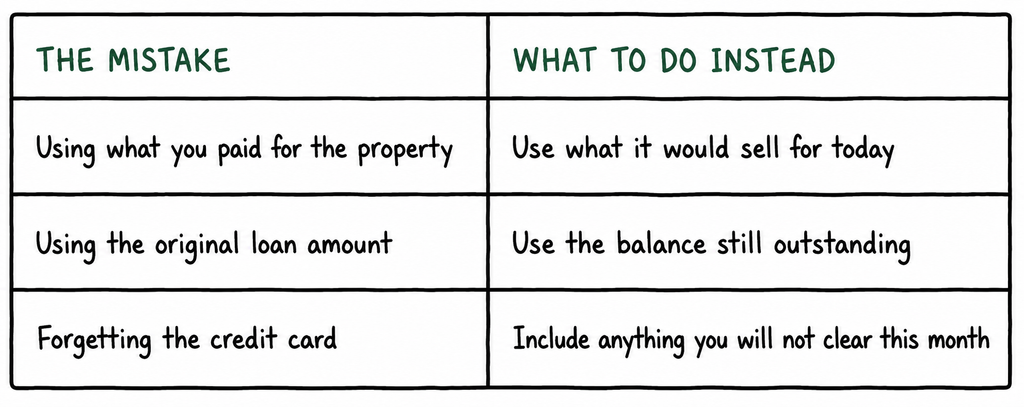
On property, be honest rather than hopeful. Use a price a buyer would actually pay this month, not the highest number quoted in your building. Jewellery is worth less than you think when you sell it. Making charges do not come back. Value the gold, not the bill. Leave out the car, the phone and the furniture. They lose value every year and you are not going to sell them. Including them only flatters the number.
What the number is for
Net worth on any single day is close to meaningless. Nobody has a good or bad net worth at thirty. What matters is the direction. This year against last year, on the same basis. It can rise in three ways. You save more, your investments grow, or your loans come down. That third one is quiet and it is often the largest of them early on. A year when you paid off eight lakh of a home loan and invested nothing is still a good year. The number knows that even if it did not feel like progress.
Do this once a year
There is a save button under the calculator. Press it and the date, your total assets, your total debts and the resulting net worth are kept in this browser, on this device. Nothing is saved unless you press it. Nothing is sent anywhere, and nobody else can see it. There is a delete button beside it, and clearing your browser data removes it too.
Two things worth knowing before you rely on it. It lives in this browser only, so it will not follow you to your phone. And a browser clearing out old site data can take it with it. So if these figures matter to you, keep your own copy as well. A line in a note or a spreadsheet, once a year, on the same date each time. Pick a date you will remember. The first of April works well, because it lines up with the tax year. After three or four entries you will have something more useful than any single reading. You will have a trend.
This fits neatly into a simple annual financial review, which covers what else is worth checking at the same time. If the third figure looked thin, the emergency fund calculator will tell you how much you should be able to reach, and the budget calculator shows how much you could put aside each month to get there.
This calculator is for learning. It is not personal financial advice. It is a simple snapshot and does not account for tax on sale, exit charges, lock in periods or the cost of selling anything. Nothing you type is sent anywhere. Figures are saved only if you press the save button, and only in this browser on this device, where you can delete them again at any time. For advice about your own situation, speak to a SEBI-registered investment adviser.