
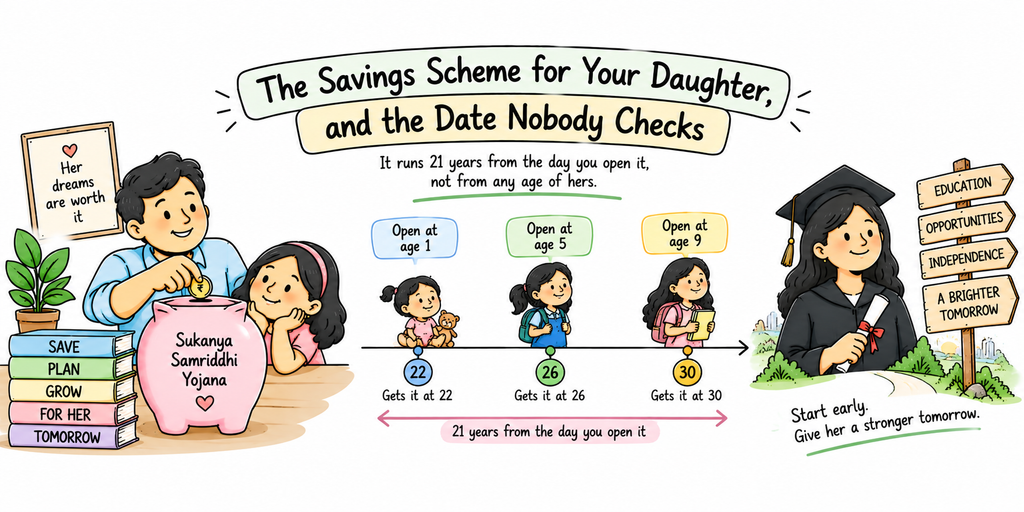
There is a government savings scheme meant for a daughter, called the Sukanya Samriddhi Yojana. It pays a good rate, and the money comes out free of tax.
It is a decent thing to own. But it has a date problem that almost nobody checks before opening one, and that date is the reason many parents find the money locked up on the day they need it.
What it is, in plain terms
- A parent or guardian opens it, and only before the girl turns 10.
- You can put in ₹250 to ₹1,50,000 in a year.
- You pay in for 15 years. After that it keeps earning on its own.
- It currently pays 8.2% a year. The government resets that rate every three months.
- The interest and the final amount are free of tax.
That is a strong set of terms. Very little else in India pays 8.2% with no tax at the end.
Now the date
The account runs for 21 years from the day you open it. Not until she turns 18. Not until she turns 21. Twenty one years from the opening date.
So the age she can finally take all of it depends entirely on when you started.
- Opened when she is 1: she gets it at 22.
- Opened when she is 5: she gets it at 26.
- Opened when she is 9: she gets it at 30.
College usually starts at 18.
You can take some money out at 18, but only half of what was in the account at the end of the previous year. Not half of what you paid in. Half the balance.
What that looks like with real numbers
Say you open it when she is 1 and pay in the full ₹1,50,000 every year for 15 years. That is ₹22.5 lakh of your own money.
When she turns 18 and the fees are due, the account holds about ₹52.4 lakh.
You may take out ₹26.2 lakh of it.
The rest stays until she is 22. That is fine if the course is cheap or she studies in India. It is a problem if you were counting on all of it.
Put the same money into an ordinary index fund and at that same moment you would have about ₹70.6 lakh, and every rupee of it available.
Is the rate good, though?
Yes. Genuinely.
Because there is no tax at the end, 8.2% here is worth more than 8.2% somewhere taxed. To match it, a normal equity investment would need to earn about 9.43% before tax. A fixed deposit would need almost 12%.
And it is guaranteed. No market year ruins it.
Over the full 21 years, paying in the maximum, you end with about ₹71.8 lakh, all yours.
The same money in an index fund, if it grew 11% a year, would be about ₹1.07 crore. After tax on the gain that is roughly ₹96.3 lakh. So the fund would be ahead by around ₹24.5 lakh.
But that gap is a guess. The 11% is not promised to anyone. The 8.2% is.
One tax change to know about
People often say this scheme saves tax three times over. That is no longer true for most people.
The deduction you used to get for putting money in only exists on the older tax regime. The newer one is now the default, and if you never chose, you are on it. On that regime, your deposits reduce your taxable income by nothing.
The good news is that the rest survives. The interest and the final amount stay free of tax on both regimes. That is the part that matters most, and it is intact.
So how should you use it?
Treat it as the safe part of the money, not the whole plan.
- Open it as early as you can. Every year you wait pushes the payout a year further past the age she needs it. This is the single most important thing on this page.
- Do not plan to fund college from it alone. At 18 you can reach only half. Work out the shortfall now, not in the year she applies.
- Keep something you can actually reach at 18 as well. A plain fund has no lock and no rules about who may spend it. That is what covers the gap. Your first index fund covers how to pick one.
- Remember the ₹1,50,000 ceiling. It cannot be your whole plan for a large goal, whatever anyone tells you.
- Work out the actual goal first. The price you planned for is not the price you will pay does the sums on what a course really costs by the time she gets there.
Used that way it is a good account. A guaranteed 8.2% with no tax is a fine home for the part of her money that must be there whatever happens.
Used as the whole answer, it is a scheme named after a girl’s future that hands over most of the money four years after she needed it.
This article is for learning. It is not personal financial advice, and no fund or company is named or recommended here. The rate on this scheme is set by the government and changes every three months, so check the current one. Rules on who may open an account, how much may go in and when money may be taken out are set by the government and can change. The 11% growth used for comparison is an example to show how the sums work, not a promise, and money in shares can fall. Tax rules change with every Budget. For advice about your own situation, speak to a SEBI-registered investment adviser.