
There are two tax regimes. Most people are on the newer one without ever choosing it. This works out what you pay on each. Then it tells you which is cheaper for you.
It also tells you what to go and ask your HR team.
Your pay
Gross salary before any deductions.
Usually 40% to 50% of your salary. Check your payslip.
What you can claim, older regime only
Section 123, which everyone still calls 80C. Provident fund, life insurance, ELSS, school fees. Capped at ₹1.5 lakh.
Section 126, earlier 80D. For you and your parents.
Section 22, earlier 24(b). Capped at ₹2 lakh for the house you live in.
Leave at zero if you own your home.
Schedule II, earlier 10(13A). From your payslip.
Delhi, Mumbai, Kolkata or Chennai.
Perks that work on both regimes
Up to ₹8,800 a month is tax free from April 2026.
Section 124, earlier 80CCD(2). Up to 14% of basic on the newer regime, 10% on the older one. Ask your HR.
You should be on the
newer regime
Your tax is ₹1,92,400, which is ₹2,21,000 less than the older regime.
About those section numbers
The Income-tax Act 2025 replaced the 1961 Act on 1 April 2026. Every number changed.
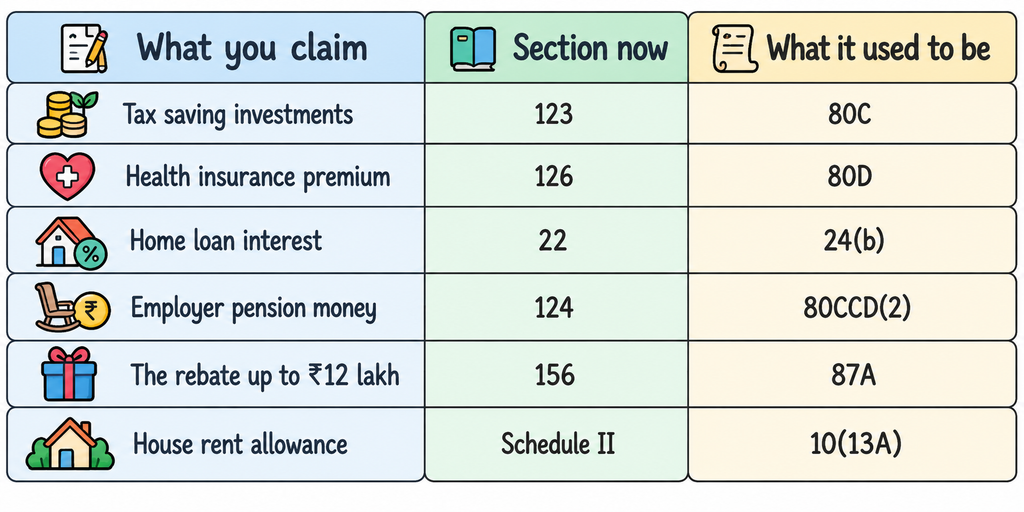
The rules did not change. Only the numbers did. Both are shown above so you can follow either.
One thing to watch. A return you file now for last year still runs on the old numbers. So your CA may say 80C and be quite right.
Three things this does not cover
- Surcharge above ₹50 lakh. It is left out. So a big pay packet will show less tax here than you really pay.
- Income that is not pay. Rent, share gains and bank interest are taxed their own way. The capital gains calculator does the second one.
- The smaller claims. Study loan interest, gifts to charity and a claim for disability all sit on the older regime. None is here.
Old regime or new regime explains the choice in words. The salary perks that still work covers the meal card and the pension money. And the twelve lakh cliff explains the line your tax jumps at.
This calculator is for learning. It is not tax advice for you. No company, fund or card is named or backed here. Figures are for someone living in India, below 60, in tax year 2026-27, with 4% cess added. Surcharge above ₹50 lakh is left out. It assumes salary is your only income. It also assumes your employer really offers the perks you enter. Caps used are the legal ones for each claim, shown in the hints beside each box. Your own payslip will differ. So will your employer's rules. Tax rules change with every Budget. For advice about your own case, speak to a qualified tax adviser.