Most advice about salary perks is written for a tax regime you are probably not on.
The newer regime is the default now. If you never picked one, you are on it. And it threw out nearly every perk people still talk about.
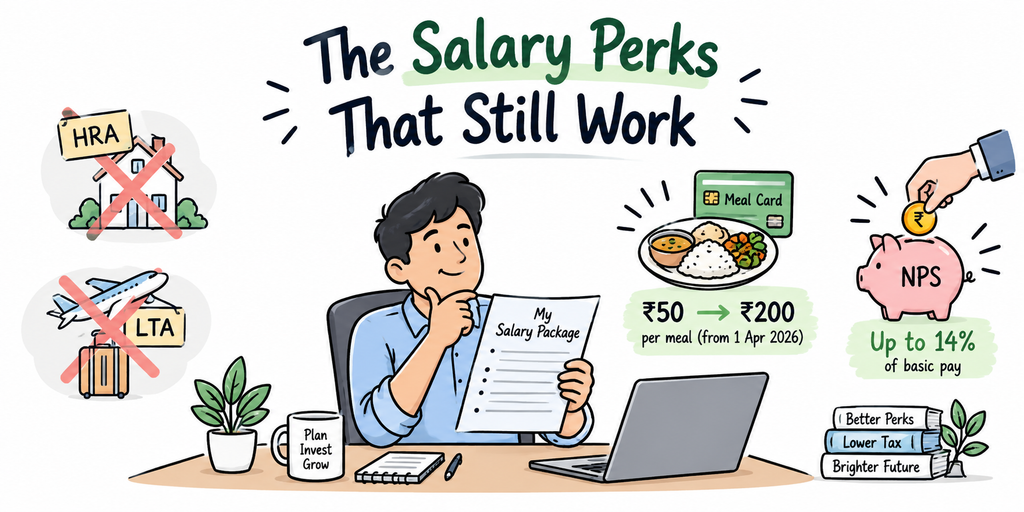
Two survived. One of them got four times bigger this April, and hardly anyone has noticed.
What died
House rent allowance. Gone on the newer regime. The whole amount is just pay, and it is taxed like pay.
Leave travel allowance. Also gone. So is the yearly ritual of hunting for flight bills in March.
Both still work on the older regime. If you are on that one, keep claiming them. Old regime or new regime works out which one suits you.
For most people the answer is the newer one. So read on.
What lived, and what changed
Three things still work on the newer regime.
- The flat ₹75,000 taken off your pay. It is automatic. You do nothing.
- Money your employer puts into your pension. Up to 14% of your basic pay.
- A meal card. This is the one that changed.
The meal limit had been ₹50 a meal since 2001. From 1 April 2026 it is ₹200 a meal.
There is a second change, and it matters just as much. The old rules had a line that blocked meal cards for anyone on the newer regime. The new rules dropped that line. So it now works on both.
Two meals a day, twenty two working days, twelve months. That is ₹1,05,600 a year of pay that is not taxed.
It used to be ₹26,400. These are the same rules that made company cars worse, which a car through work covers. This part went the other way.
What the meal card is worth
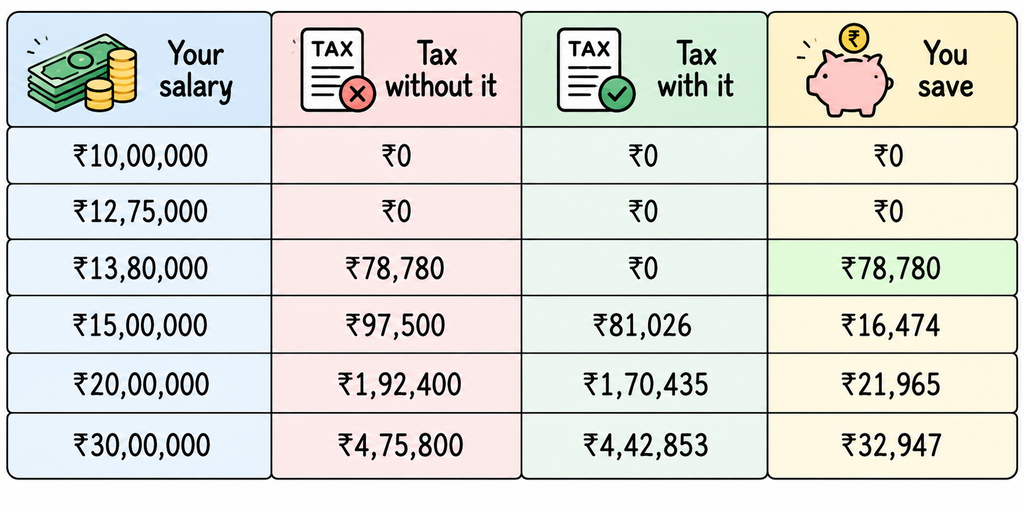
Read that table twice. It does not behave the way you expect.
At the top it saves about a third of the amount, which is just your tax rate. At ₹10 lakh it saves nothing at all. And in the middle, at ₹13,80,000, it wipes out the entire bill.
The sweet spot
There is a line at ₹12,00,000 of taxable income. Below it you pay no tax. Cross it and you do. The twelve lakh cliff explains that line.
A meal card lowers your taxable pay. So if you are sitting just above that line, it can push you back under it.
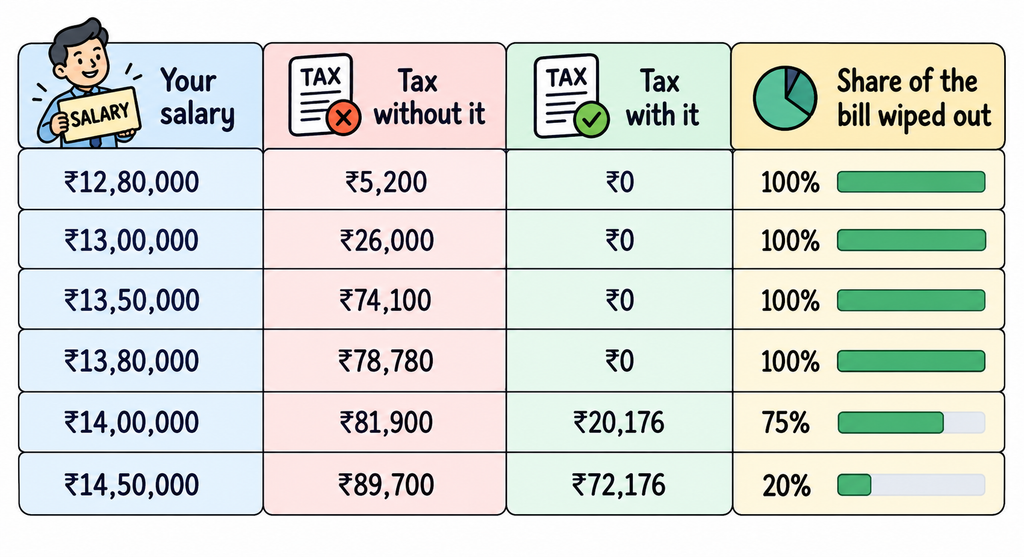
Up to a salary of about ₹13,80,600, a meal card takes your tax to nil.
If you earn in that band, this is the most valuable thing on this page. A perk most people treat as a small nicety is paying your whole tax bill.
When it is worth nothing
Now the other end, and this is the part nobody tells you.
If your salary is under about ₹12,75,000, you already pay no tax. The rebate handles it.
So a meal card saves you nothing. Neither does pension money. Neither does anything else.
You cannot save tax you were never going to pay.
This matters because perks are not free. A meal card gives you money you can only spend on food. Pension money is locked until you are 60. If neither saves you any tax, you have given up free cash for nothing.
Below that line, take the cash. Every time.
Pension money is real, but it is not free
Your employer can put up to 14% of your basic pay into your pension, and it is not taxed.
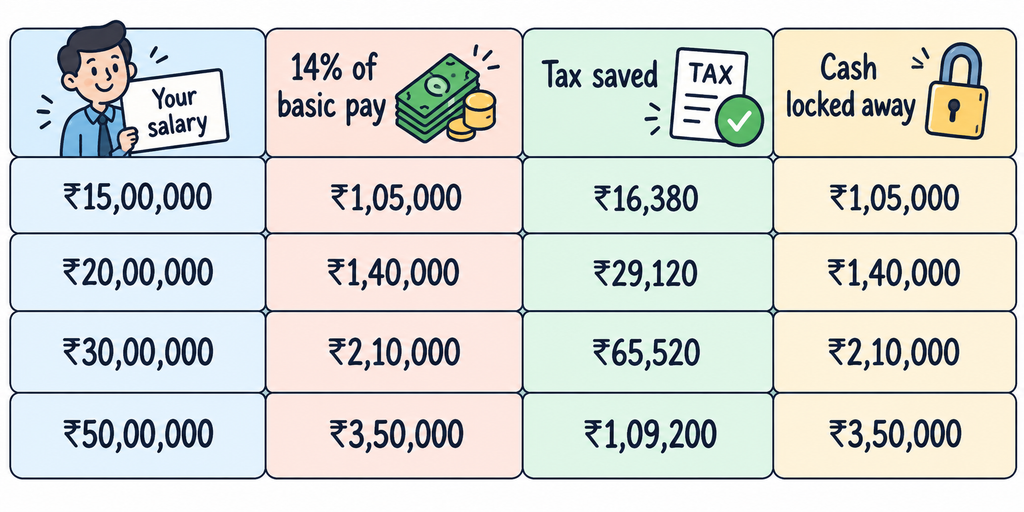
Look at the last two columns together. At ₹50 lakh you save ₹1,09,200 of tax. You also hand over ₹3,50,000 that you cannot touch for decades.
That money comes out of your pay package, so your take home drops by the full amount. And at the end you cannot simply take it all out. A large part has to buy a monthly income, which what you are really buying with an annuity works through.
So it is worth taking if you wanted to save that money anyway. It is a poor deal if you are only doing it for the tax.
The meal card has no such catch. You were going to eat.
The rules on the meal card
It only works if it is done properly.
- It cannot be cash. A food allowance paid into your bank is taxed in full. It has to be a card or voucher.
- It can only be spent on food. At eating places, or in the office canteen.
- It cannot be passed to someone else.
- The limit is per meal, not per month. Two meals a working day is the usual basis.
Many employers still load these at the old ₹50 rate, because their payroll was set up years ago. That is the thing to go and ask about.
What to do
- Find your salary on the first table. If you are under ₹12,75,000, stop here and take cash instead of perks.
- Ask payroll what rate your meal card is set at. If it still says ₹50 a meal, ask for ₹200. This is one email and it is worth up to ₹32,947 a year.
- If you earn between ₹12.75 lakh and ₹13.8 lakh, do this first. It can take your whole bill to nil. Nothing else you do this year will match it.
- Take pension money only if you wanted to save it anyway. The tax break is real. So is the lock.
- Stop chasing rent and travel claims unless you are on the older regime. They do nothing on the newer one.
- Do not let a perk decide your spending. A card that must be spent on food is only a saving if you were buying the food anyway. The budget calculator shows what your pay actually has to cover.
Most salary perks are gone. The two that are left are worth real money, but only above a certain pay, and only if you were going to spend or save that money anyway.
That is a much shorter list than the one your office is still circulating.
This article is for learning. It is not personal tax advice, and no company or card is named or backed here. Figures are for a resident individual on the newer regime in tax year 2026-27, with 4% cess added. They assume basic pay is half of salary, two meals on each of twenty two working days a month, and no other income or claims. Your own payslip will differ. Surcharge applies at higher incomes and is ignored here. The meal limit of ₹200 a meal and its availability on the newer regime come from the rules notified in March 2026 and in force from 1 April 2026. What your employer actually offers, and at what rate, is their decision. Tax rules change with every Budget. For advice about your own situation, speak to a qualified tax professional.