
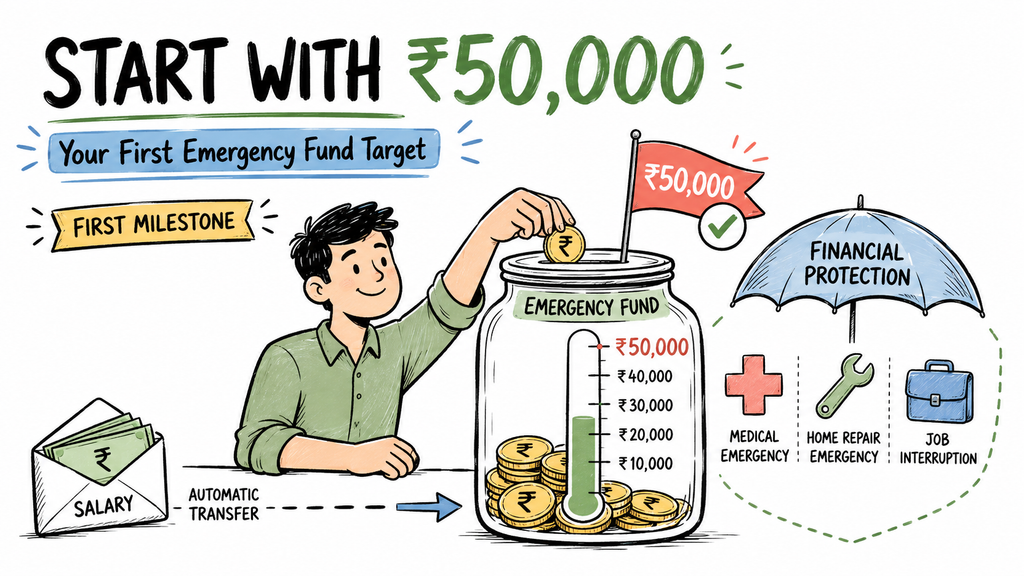
Everyone tells you to build six months of expenses before you invest.
If you are earning thirty thousand a month, that is a target somewhere north of a lakh. From zero, with rent to pay, it is not a goal. It is a wall.
So aim at fifty thousand instead, and do not think about six months until you get there.
1. Why a Flat Number Beats a Formula
Six months of expenses is the right answer eventually. It is a terrible first target.
Three reasons. It is too far away. Anything that takes three years to reach stops feeling like a goal after about month four. It moves. Work it out from a percentage of your spending and the target rises every time your rent does. You can save steadily and watch the finish line walk away from you. And it makes you do sums before you have done anything. People spend a fortnight working out their exact essential spending and then never open the account.
Fifty thousand has none of those problems. It does not move, you can picture it, and you can start today without working anything out. Once it is sitting there, the bigger target becomes a sensible question rather than a discouraging one. That is the right time to work out what your real number is, and build an emergency fund that fits your life covers how.
2. What Fifty Thousand Actually Buys
It is not retirement money. It is the difference between an annoying month and a bad year.
Here is what it covers.
- A laptop or phone dying the week before a deadline
- A flight home at short notice when something happens in the family
- The deposit on a new flat when you have to move in a hurry
- The part of a hospital bill your insurance does not pay
- Four or five weeks between one job and the next
Notice what these have in common. Every one of them, without savings, goes on a credit card. That is the real job of this money. Not to make you rich, but to keep one bad week from turning into a card balance at forty per cent that follows you for two years. A person with fifty thousand put aside and a person with nothing face the same emergency. They do not face the same next eighteen months.
3. Getting There From Zero
The number is fixed, so the only question is how long you want to take.
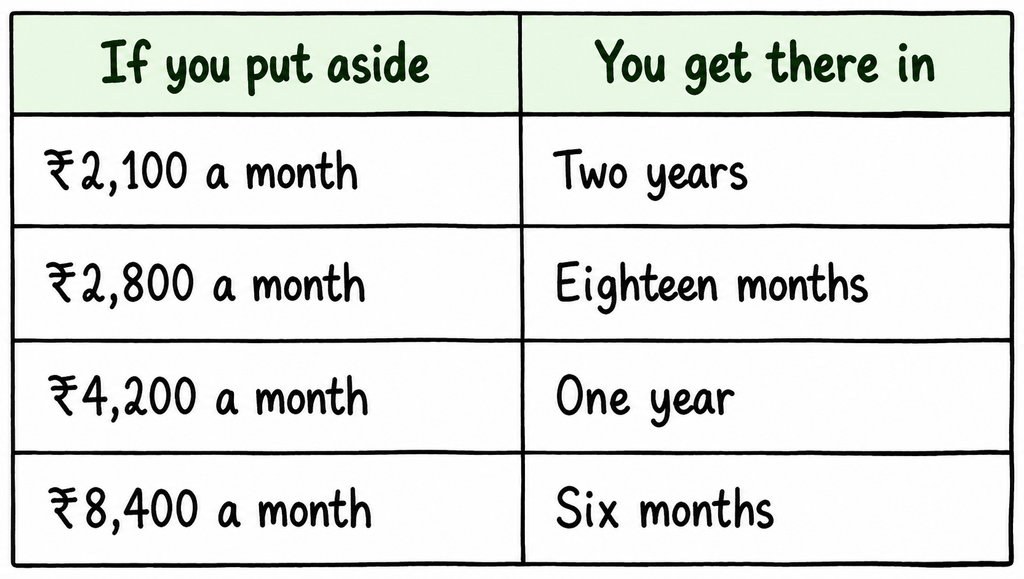
Pick the row you can hold in a bad month, not the one you can manage in a good one. Two years feels slow. It is still two years faster than the version where you wait until you can afford eight thousand a month. Set it up as a standing instruction dated a day or two after your salary lands, so it happens before you can spend it. The reasoning behind that is in pay yourself first.
One shortcut worth taking. Money that arrives unexpectedly should go straight here until the fifty thousand is complete. A bonus, a tax refund, a gift at a wedding. You were not counting on it, so you will not miss it. Most people who reach this milestone quickly get there on one bonus and six months of small transfers, not on discipline alone.
4. The Fast Access Detail Nobody Mentions
Keep this money somewhere boring. A savings account, a sweep in fixed deposit, or a liquid fund. If you choose a liquid fund, there is a rule worth knowing before you need the money rather than after. Liquid funds offer instant withdrawal, but it is capped.
SEBI’s rules set that cap at fifty thousand rupees, or ninety per cent of what you hold in the scheme. Whichever of the two is lower. And it applies per day, per scheme. Read that again with your starter fund in mind. If you hold exactly fifty thousand in one liquid fund, the instant route gives you forty five thousand, not fifty. The rest arrives the next working day. That is usually fine. It is not fine at eleven at night in a hospital corridor. So split it. Keep the first ten or fifteen thousand in your savings account, where it is yours at any hour of any day. Put the rest wherever it earns a little more.
The split matters more than the return. Holding fifteen thousand in a savings account instead of a liquid fund might cost you five hundred rupees over a year. Being able to reach that money at midnight is worth more than five hundred rupees.
5. Rules for When You Spend It
You will spend it. That is what it is for, and spending it is not failure. What matters is having decided in advance what counts.
- An emergency is unexpected, necessary and urgent. All three. A wedding you have known about since January is none of them.
- A sale is not an emergency. Neither is a holiday, however much you need one.
- Refill it before you go back to investing. Treat it like a loan to yourself with the same standing instruction that built it.
- Keep it out of sight. A separate account, ideally at a different bank, without a card attached to it.
That last one does more work than any rule you write down. Money you can see when you check your balance is money you will eventually find a reason to use.
When you are ready to work out your real target, the emergency fund calculator will size it from your own spending and show you where to hold each part. And if you are not sure what you can put aside each month, the budget calculator works it out from your pay and your rent.
This article is for learning. It is not personal financial advice. The instant withdrawal limit described here comes from SEBI’s rules for that facility and applies per day and per scheme, but individual fund houses may apply their own conditions, so check before you rely on it. Liquid funds are not guaranteed and their value can move, unlike money in a savings account. For advice about your own situation, speak to a SEBI-registered investment adviser.