

A credit score is a three digit number that decides what a bank charges you. Most people ignore it until the week they ask for a home loan. By then it is too late. It is built slowly, and it cannot be fixed in a hurry.
Here is what it is worth in rupees.
One point on the rate
Banks charge different people different rates for the same loan. A good score gets the cheap rate. A middling one gets a rate half a point to a full point higher.
That sounds tiny. Put it on a real loan and it is not.
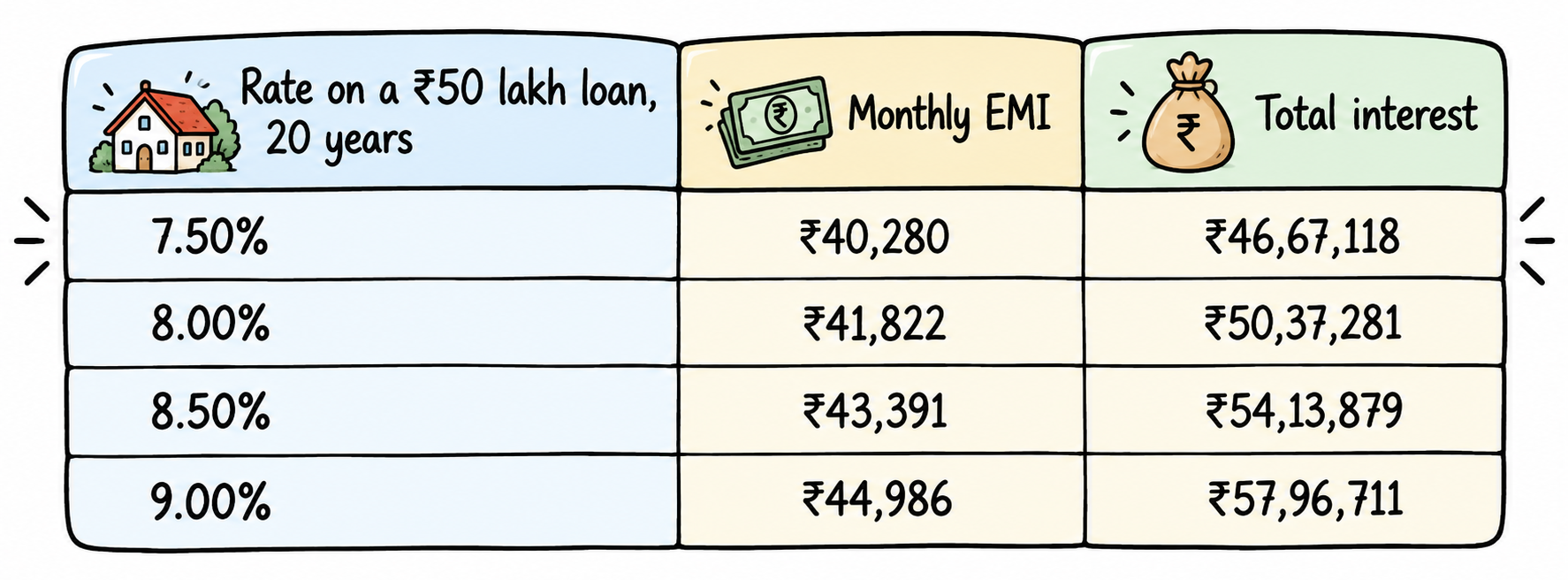
From 7.5% to 8.5% is one point. It costs you ₹3,112 more each month, and ₹7,46,760 across the twenty years. Even half a point is ₹3,70,163. That is the whole reason to care. Not the number. What the number costs.
You do not have one score. You have four.
Most people use a brand name for this, as though only one score existed. Four firms are licensed to keep credit records in India. Each works out its own number. They do not all hold the same records. A lender may report to some and not others. So your four scores will differ, often by a lot. The bank picks the one it uses. You do not get to choose.
Most run from 300 to 900. Above about 750 you are in good shape. Below 700 you pay more, or you are turned down.
What the number is made of
The firms do not publish their exact method. The broad shape is well known, and it is roughly this.
- Paying on time, about 35%. The biggest piece by far. Each payment made on the due date helps. Each late one hurts.
- How much of your limit you use, about 30%. More on this below. It is the one you can move quickest.
- How long you have had credit, and what kinds, about 25%. An old account helps. Holding both a loan and a card helps a little.
- How often you have asked for credit lately, the rest. Each request leaves a mark.
Treat those shares as a rough guide. Anyone quoting them to one decimal place is guessing.
The part almost everyone gets wrong
The second item is how much of your card limit you use. Banks call it utilisation. If your limit is ₹2,00,000 and you have spent ₹60,000, you are using 30%. Under 30% is the usual advice.
Now the trap. Your bank reports what you owe on the statement date, not on the day you pay the bill. So you can pay in full each month, never owe a rupee of interest, and still show 90% used. The record only ever sees the high number.
Two easy fixes. Pay part of the bill before the statement date rather than after. Or ask for a higher limit and do not spend it, which drops the share without changing a thing you do. This is the fastest honest way to move a score, and it takes one phone call.
Four ways people hurt their own score
- Closing the oldest card. It feels tidy. It cuts your history short and drops your total limit, so your used share jumps. If it is free to keep, keep it and use it now and then.
- Asking six lenders in one week. Each one leaves a mark, and a cluster of them reads badly. Compare rates by asking what they charge, not by applying.
- Backing someone else’s loan. It lands on your record the day you sign, and their missed payments become yours. When your money is also the family’s money covers what you are really agreeing to.
- Paying only the minimum. It keeps you on time on paper while the balance grows. The minimum payment calculator shows where that ends.
The rules are on your side now
Several things have changed, and hardly anyone knows.
- Four free reports a year. Each of the four firms must give you one full report a year, free. That is four, not one.
- Records update every fortnight. Since January 2025 lenders must report twice a month instead of once. Paying on time now shows up in weeks, not months.
- You get told when someone looks. When a lender checks your report, you must be sent a message. An alert you did not expect is worth chasing.
- Mistakes must be fixed in 30 days. If they are not, the firm owes you ₹100 for each day it is late.
That last one matters more than it sounds. Errors on these reports are common. A loan you closed still showing as live. A card you never held. Someone else’s default under a name like yours. Nobody checks this for you. If you never look, the mistake sits there until the day it costs you a rate.
How long it takes
You cannot hack this. There is no trick, and anyone selling one is selling something else. Roughly what to expect, if you start today.
- An error removed: up to 30 days, once you report it.
- A lower used share: one or two bills.
- Getting over a missed payment: many months of paying on time.
- Building a record from nothing: a year or more.
So start about a year before you want the loan, not a month.
What to do
- Get all four free reports. Not one. Read every line and check each account is really yours.
- Report anything wrong, in writing. Keep the date you raised it. The 30 day clock and the ₹100 a day both depend on it.
- Put every bill on auto pay. On time is 35% of the whole thing, and that part needs no cleverness. Setting up automatic payments shows how to do it without nasty surprises.
- Get under 30% of your limit. Pay early in the month, or raise the limit and leave it alone.
- Stop asking for new credit. For six months before a home loan, apply for nothing else.
- Clear costly debt first. It lifts the score and saves far more than the score will. The debt payoff calculator gives the order.
None of that is clever. It is just early. A year of dull payments made on time is worth ₹7 lakh on a home loan. Very few things you can do with an hour a month pay like that.
This article is for learning. It is not personal financial advice, and no bank, lender or credit firm is named or backed here. The rates used are examples chosen to show the size of a rate gap, not quotes. Real rates depend on the lender, your income, the property and the day, and they change all the time. Scoring methods are set by the credit firms and are not published in full, so the shares given are the widely reported shape and not an official rule. Credit reporting rules are set by the Reserve Bank of India and can change. For advice about your own borrowing, speak to your lender or a SEBI-registered investment adviser.