
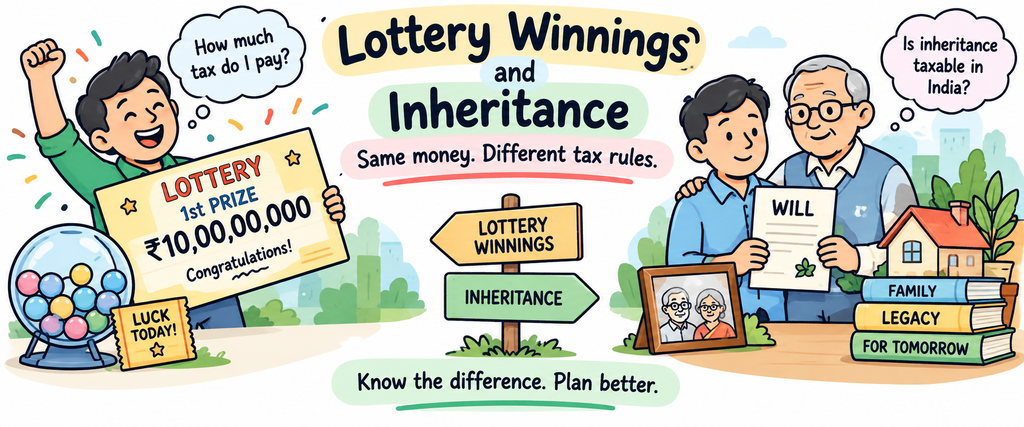
Money that arrives all at once feels the same whatever its source. A win, a legacy, the sale of a business. The tax does not see it that way. Two kinds of sudden money are treated as near opposites, and the gap between them is enormous. On the same ₹1 crore, the difference works out at about ₹25 lakh.
A prize is the worst kind
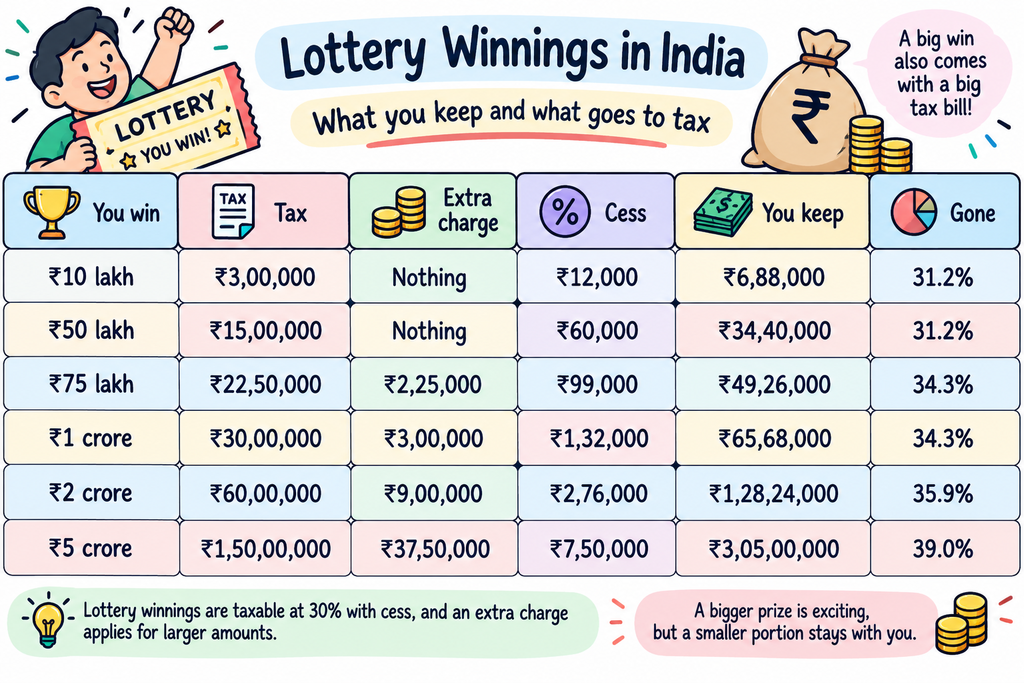
Winnings get their own rule, and it is a harsh one. A flat 30%, whatever else you earn. Not your slab. The slab system does not apply at all. Nor does anything that normally reduces a tax bill.
- No tax free amount to start with. Every rupee is taxed, right from the first one.
- No deductions. Nothing you put into savings reduces it.
- No losses allowed against it. A bad year elsewhere does not help.
- No spreading it out. It all lands in one year.
On top of the 30% there is a 4% cess. Past ₹50 lakh an extra charge starts, and it grows as the prize does.
What winners are not told
They cut the tax before handing the money over. That feels like the end of it. It is not. What they cut is the plain 30%. The extra charge and the cess are not taken out. You have to pay those yourself.
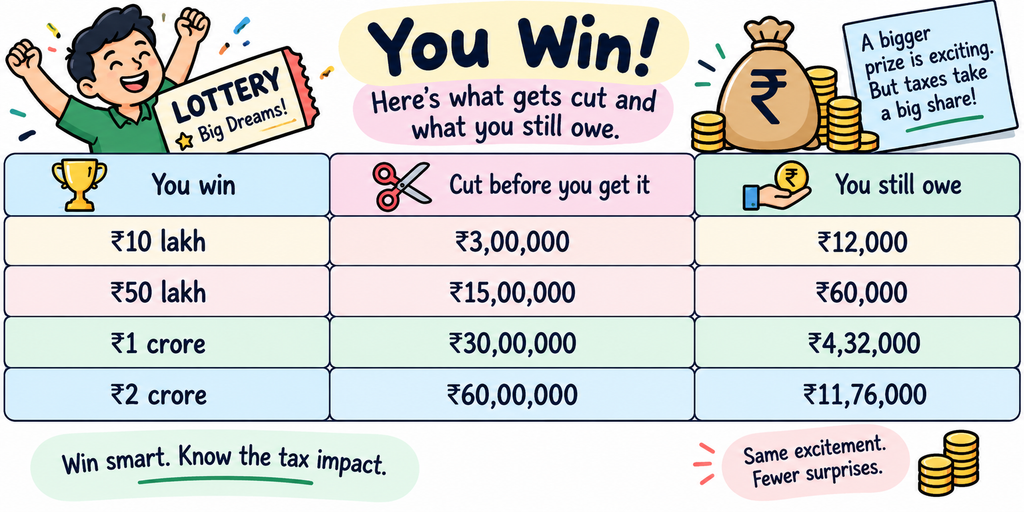
Win a crore and ₹4,32,000 is still yours to pay. Nobody sends a bill. It is your job to work it out and hand it over. Worse, it is wanted during the year, not at filing time. The advance tax dates covers what happens if you leave it.
An inheritance is the opposite
Now the other kind. Someone dies and leaves you what they had. Nothing at all is due when it reaches you. India had a death tax once. It went in 1985 and nothing replaced it. A flat, shares, gold, money in a bank. You receive it and owe nothing. That is the whole rule. But something comes attached, and this is where people are caught.
The asset keeps the price the dead person paid, and the date they bought it. Not what it is worth today. Say your father bought a flat in 2008 for ₹20 lakh. It is worth ₹1 crore now. You inherit it and owe nothing. Sell it and the gain is not measured from ₹1 crore. It is counted from his ₹20 lakh, eighteen years ago. Because he bought before July 2024 you get a choice of two ways to work it out. Lifting his old cost for inflation turns it into ₹56,05,839, so the gain is ₹43,94,161 and the tax is ₹9,13,985. That is the cheaper of the two. Downsizing your home works through that choice properly.
So the flat is worth ₹1 crore while you hold it, and ₹90,86,015 the moment you sell.
Side by side
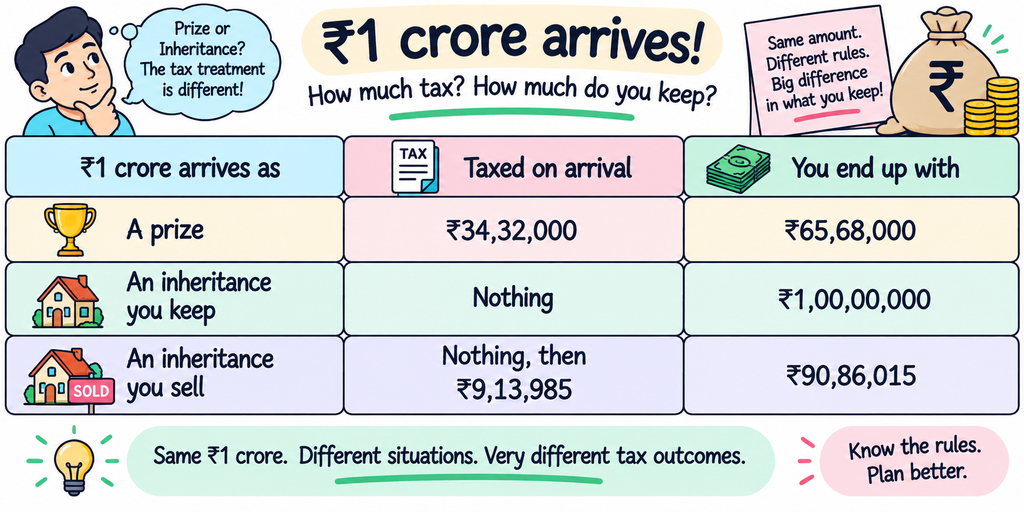
Same number on the cheque. ₹25,18,015 apart. So how the money reaches you matters more than how much it is. Find that out before you plan around the amount.
Then do nothing for six months
Once the tax is set aside, the hard part starts. Everyone has a plan for your money, and some of them are related to you. The useful rule here is a boring one. Put the money somewhere safe, and take no big decision for six months. Not because waiting earns more. Because the decisions are hard to undo. A flat you buy in the first month cannot be returned in the fourth. A business someone talked you into is hard to leave. Money lent to family does not come back, whatever is said at the time.
Waiting costs you nothing. That ₹65,68,000 sitting in a plain deposit earns about ₹38,313 a month, which is ₹2,29,880 over the six months. You lose nothing by thinking. Six months is also long enough for most people to stop asking.
What could go wrong
- Spending the tax. On a crore, over ₹34 lakh was never yours. Move it out on day one, before you work out what is left.
- Thinking a flat left to you is worth its market price. It is worth that, less the tax waiting inside it. The capital gains calculator works out how much.
- Not finding out what they paid. Old purchase papers decide your tax bill decades later. If the family still has them, scan them now. What to do about the money after a death covers which papers to look for.
- Quitting your job in the first month. A crore sounds like freedom. After tax it is ₹65 lakh, which does not replace a salary for thirty years on its own.
- Telling everyone. You cannot take it back once said, and the requests do not stop.
What to do with this
- Work out the tax before you work out anything else. For a prize, assume a third is gone, and check whether the shortfall is still owed.
- Move that amount to a separate account the same week. Treat it as already spent, because it is.
- For anything left to you, find out what they paid. The sale deed, old bank papers, the broker’s record. Without it you may be taxed on the whole sale price.
- Park the rest somewhere dull and wait six months. Write the date down. Decide nothing big before it.
- Then turn it into a monthly income, instead of leaving it as one large sum. The three buckets covers turning a lump into something that pays out.
Sudden money is not a problem to be solved in a week. The tax is settled early and the rest can wait. Most of the harm is done in the first ninety days. With good intentions, and with everyone around you being very helpful.
This article is for learning. It is not personal tax, legal or financial advice, and no bank, fund or company is named or backed here. The figures use the rules for the tax year 2026-27 and assume you live in India and that the prize is your only large income that year. The inherited flat example assumes a purchase in 2008 at ₹20 lakh and a sale at ₹1 crore, using the inflation index for this year. Your own dates, costs and other income will give different answers, and the extra charge above ₹50 lakh has a relief at the boundaries that is not shown here. Who inherits what depends on the will, on your religion and on the law that applies to your family. Rules change with every Budget. Speak to a chartered accountant before you pay anything, and to a lawyer where a will is involved.