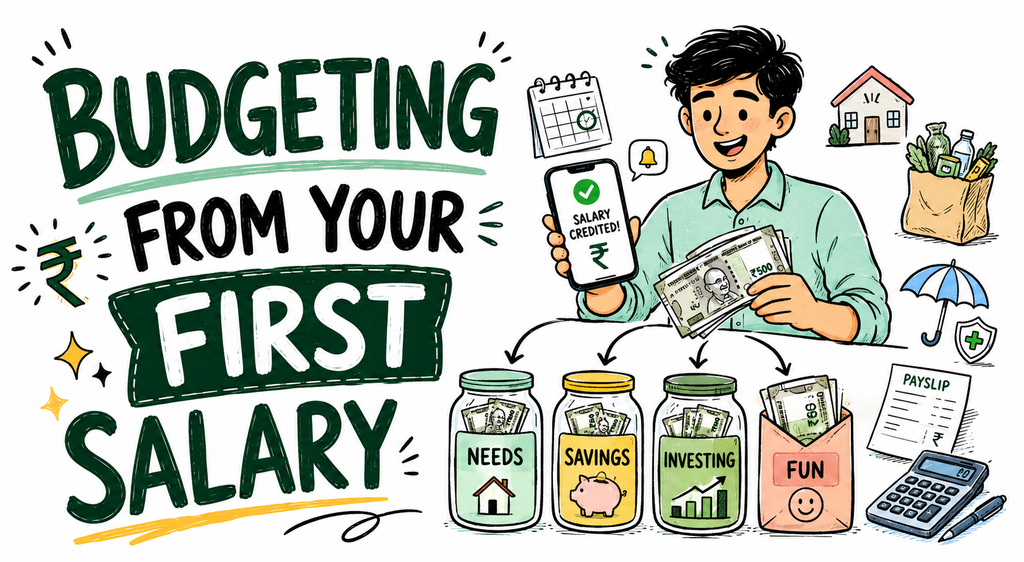
Your first salary arrives and someone tells you about 50/30/20. Half on needs, a third on wants, a fifth saved. Then you work out your rent and realise the maths does not survive contact with Bengaluru. You have not failed at budgeting. The rule was written for a different housing market.
1. The Rule Was Not Written for You
50/30/20 assumes housing is a manageable slice of what you earn. On a first job in a metro it is not a slice. It is the whole plate.
Take an IT services fresher on about four lakh a year. That lands as roughly thirty thousand a month in the bank once provident fund and tax come out. A room in a shared flat in Bengaluru runs somewhere from eight to fifteen thousand, depending how far you are willing to live from the office. Say twelve thousand. That is already forty per cent of your pay, and the rule wanted your entire needs bucket to be fifty. You have used four fifths of the needs budget before buying a single meal.
This is not a flaw in you and it is not really a flaw in the rule either. The rule is a rough shape from a country where a young worker spent a quarter of their pay on housing. In a city where rent is closer to forty per cent, the same three buckets still make sense. The numbers on them do not.
2. What a First Salary Actually Looks Like
Here is the same person, written out honestly.
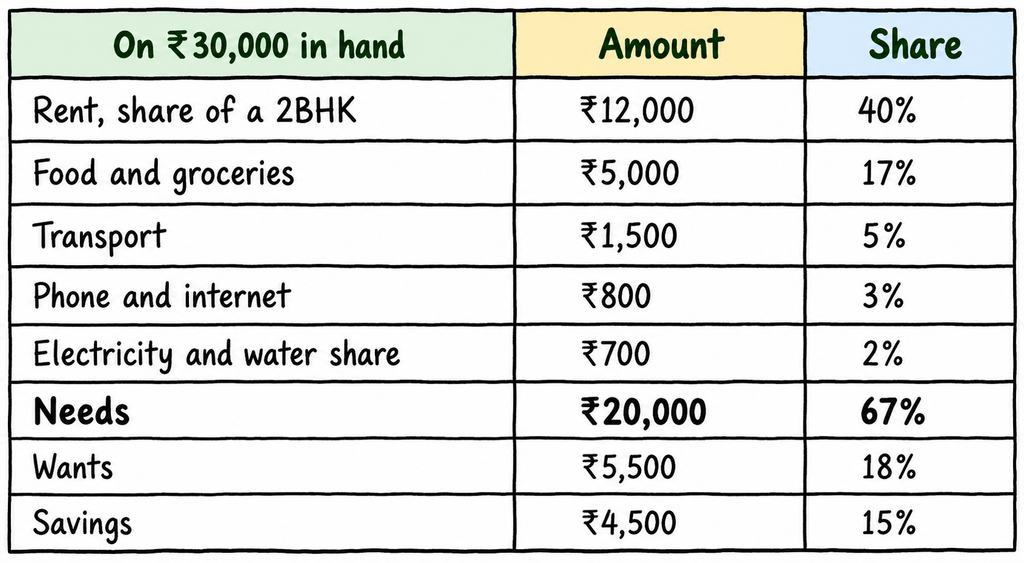
That is 67/18/15. Nowhere near the rule, and it is a perfectly good budget. Notice what it is not. It is not a person wasting money. Every line is either rent or something you cannot skip. The wants bucket is five and a half thousand a month. That is one dinner out a week and a subscription, and that is genuinely all it stretches to. Anyone telling you to save twenty per cent of this is asking you to find six thousand a month from a budget with five and a half thousand of slack in it.
3. Aim for Fifteen, Not Twenty
Fifteen per cent is the honest target on a first salary in a metro. Some months it will be ten. That is not a lowered standard. It is the same standard applied to a real income. And fifteen per cent is not nothing. Four and a half thousand a month, kept up for a year, is about fifty seven thousand with a little growth on top. That is your first emergency fund, almost exactly, in your first year of working.
The thing that matters at this stage is not the percentage. It is that the transfer happens every month without you deciding. Someone saving ten per cent automatically will finish the decade far ahead of someone who means to save twenty five and manages it four times a year.
The first three months do not count
Nobody warns you about the start, so here it is. Your first months go on a deposit, a month of rent in advance, a mattress, a fan, kitchen things, and getting to the city in the first place. You will save nothing. Possibly you will borrow from your parents. That is what starting out costs, and it is not a sign of anything.
Start the monthly transfer once the setting up is done, not before. A savings habit you abandon in month two because the deposit was due teaches you the wrong thing about yourself.
4. The Raise Is When It Fixes Itself
Here is the part worth knowing early, because it changes how the next two years feel. Your rent does not rise with your salary. Your salary rises faster. Take the same person after one decent raise, now on thirty eight thousand, still in the same flat.
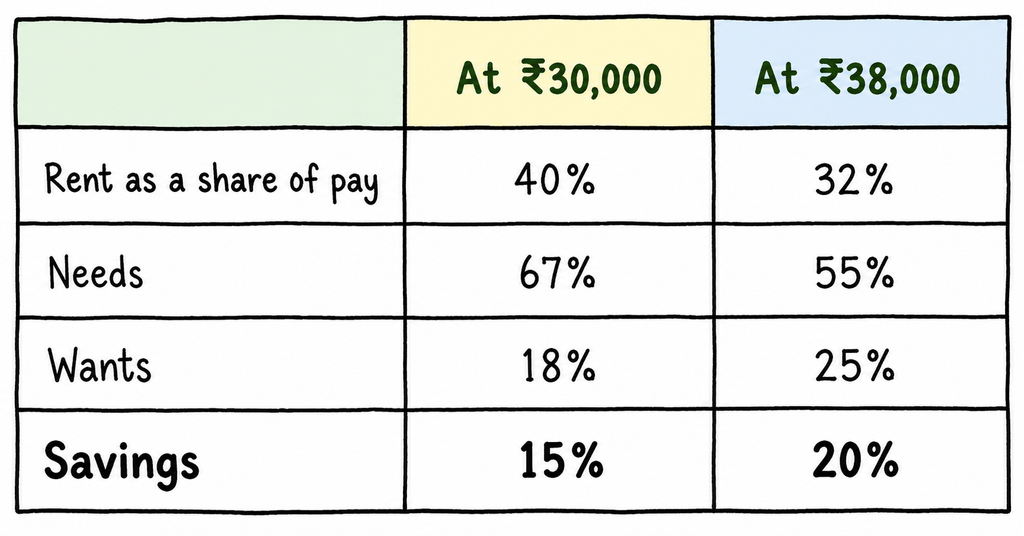
Nothing changed except the income. The ratio sorted itself out. So the fix for a tight budget on a first salary is usually not more discipline. It is time, and the next raise. Which is also the trap. If your spending grows with the raise, none of that happens and you are still at fifteen per cent three years later on twice the money. Move the savings amount up in the same week the raise lands. Before you have adjusted to it.
5. Four Things That Matter More Than the Ratio
- Sharing, for longer than feels dignified. Rent is the only line big enough to change the whole picture. A flatmate is worth more than every other economy combined.
- No EMIs in year one. A phone or a bike on instalments turns a flexible budget into a fixed one, right when your income is least predictable.
- Keep the deposit separate. You will move flats, and the new deposit is due before the old one comes back. That gap has ruined many first budgets.
- Ignore what your colleagues spend. You cannot see their rent, their loans, or what their parents cover. You are comparing your full picture to their visible one.
The last one costs more than people admit. Almost every expensive habit at twenty three started with someone else ordering it first.
Put your own numbers into the budget calculator and it will do this split from your actual rent. When you have a figure you can commit to, pay yourself first explains why the date matters more than the amount, and your first fifty thousand is the target that year one of saving is actually aiming at.
This article is for learning. It is not personal financial advice. Salary and rent figures are typical ranges for 2026 and vary enormously by city, company and area, so treat the example as a shape rather than a benchmark. The growth shown on a year of saving assumes a steady return, which no real investment provides. For advice about your own situation, speak to a SEBI-registered investment adviser.