
Money in India comes wrapped in its own language. Some of it is truly technical. Most of it is plain ideas wearing a suit. Here are thirty words you will meet in your first few years of earning, grouped by where you will run into them. Keep it in a tab. It is for looking things up, not for reading start to finish.
1. Words on Your Payslip
These decide the gap between the number in your offer letter and the number in your bank.
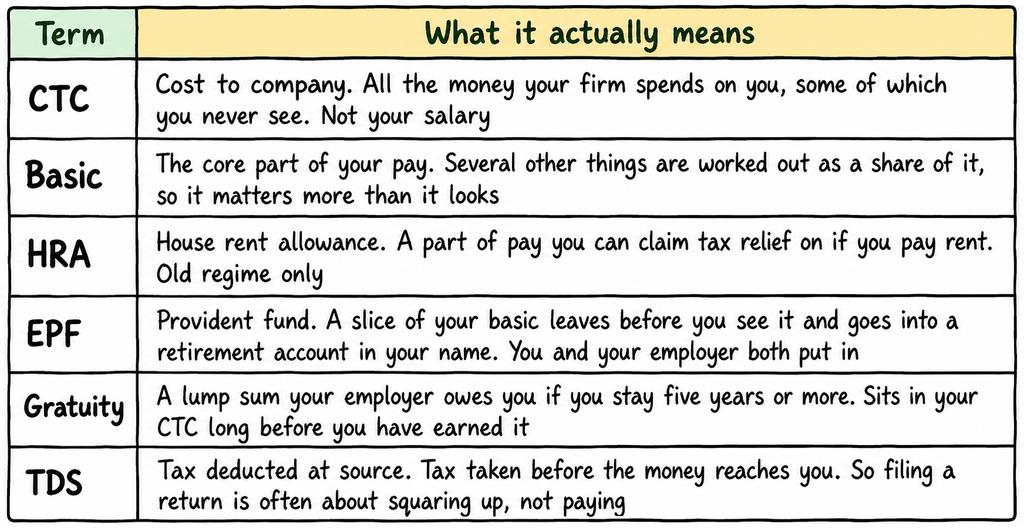
The gap between CTC and what lands in your account is usually twenty to thirty per cent. Nobody tells you this before your first payday.
2. Words About Tax
The law was rewritten. The Income Tax Act 2025 replaced the 1961 Act from April 2026, so some names you grew up with have changed.
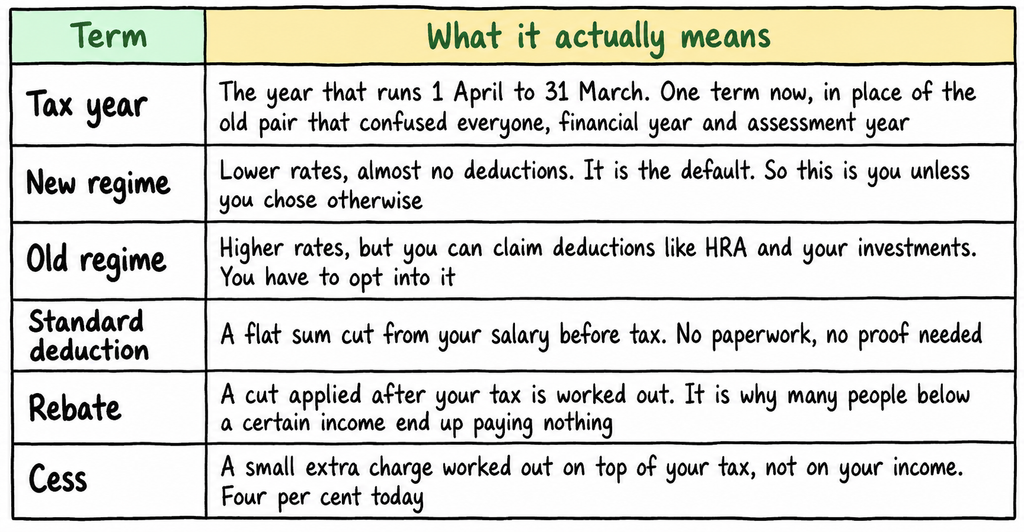
Two forms were renamed too. Form 16, the salary and tax statement from your employer, is now Form 130. Form 26AS, the tax office’s own record of your year, is now Form 168.
Which regime suits you is worked through in old regime or new regime.
3. Words About Mutual Funds
This is where the most money quietly changes hands on words people do not check.
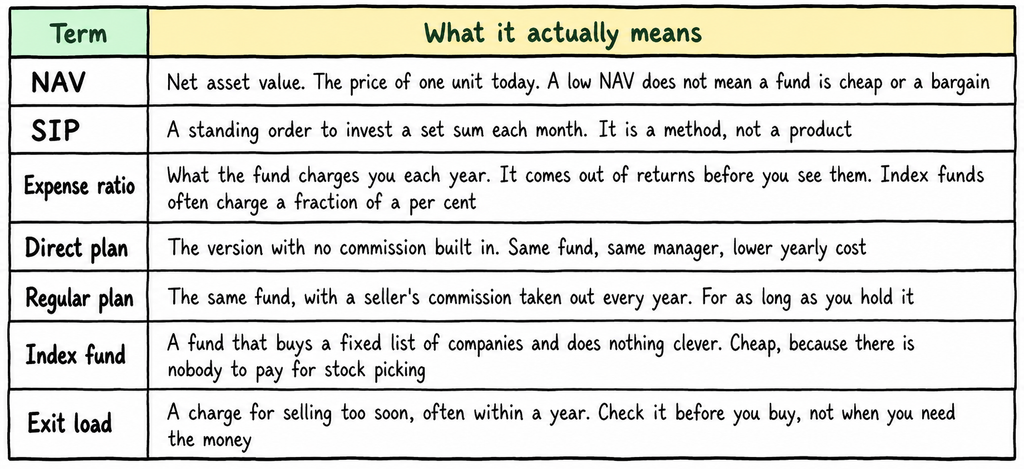
If you learn one row from that table, learn direct plan. It costs nothing to choose and it adds up for as long as you hold the fund. There is more on it in your first index fund.
4. Words About Gains and Losses
These only matter on the day you sell, which is why people meet them at the worst moment.
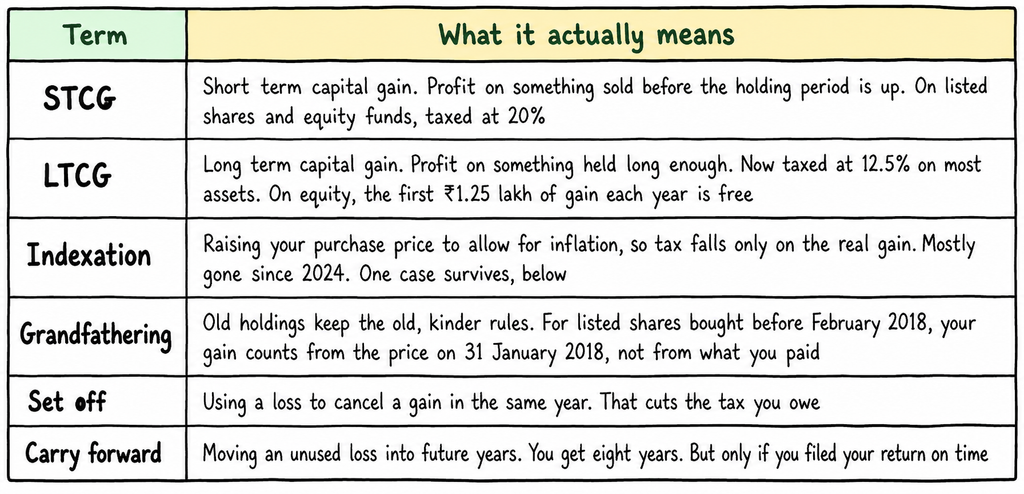
That exception is worth knowing if you own property. Bought on or before 22 July 2024, you get a one time choice. Pay 12.5% flat, or 20% with inflation allowed for, whichever is lower. Bought after that date, only the flat rate applies.
Carry forward is the row that costs people real money. Sell at a loss, file late, and the loss is gone for good. Capital gains basics covers how the pieces fit together.
5. Words About Retirement
Long words attached to money you will not touch for thirty years.
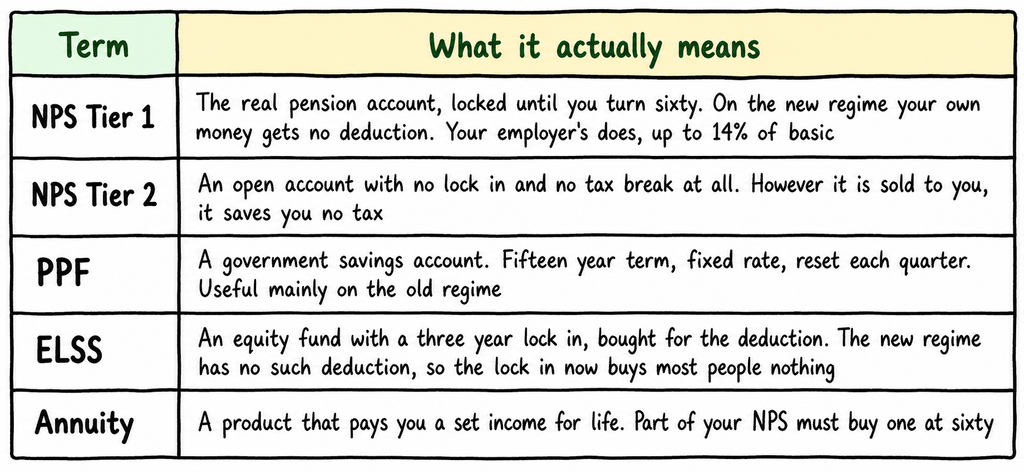
Two of those deserve a second look, because a lot of advice has not caught up with the rules.
ELSS was sold for years as the tax saving equity fund. On the new regime there is no deduction to claim. So you take a three year lock in and get nothing for it. A plain index fund does the same job without the lock.
And NPS Tier 2 has never had a tax break. If someone opens one for you saying it saves tax, be careful about the rest of their advice.
Which accounts you need, and which you can skip, is set out in the only three accounts you actually need.
This article is for learning. It is not personal financial advice. Rates, limits and form names are those for the tax year 2026-27 under the Income Tax Act 2025, and any of them can change with a Budget. These meanings are kept simple on purpose, and real cases have exceptions. Check the current position on the income tax website, or with a qualified tax adviser, before you act on any of it. For advice about your own situation, speak to a SEBI-registered investment adviser.